Disclosure: We may earn a commission when you buy through links on this page, at no extra cost to you. We buy nothing, sell nothing and accept no payment for coverage — commissions never decide what we recommend. How we make money.

If your walker or rollator feels wobbly, stop and check it before making another trip across the room or along the sidewalk. The most common causes are loose height buttons or fasteners, worn rubber tips, uneven wheels, brake problems, folding latch wear, a bent frame, or stress around a rollator seat. If the frame looks bent, a latch will not lock, brakes will not hold, or the seat support is cracked, use a backup mobility aid and get help from a qualified repair person, dealer, clinician, or caregiver.
A little movement is normal in some folding frames. But a device that rocks, twists, clicks, drifts to one side, or feels unstable under body weight needs attention. The goal is not to make a walker or rollator feel new through guesswork. It is to find the unsafe cause first, fix simple issues correctly, and know when the device should be taken out of service.
Start with a 2-minute safety check before using it again
Place the walker or rollator on a flat, dry floor and take 2 minutes to look it over from all sides. Do not test it on stairs, a ramp, thick carpet, gravel, or a curb. A level kitchen floor, hallway, or garage slab is a better place to spot rocking, uneven legs, or a wheel that does not sit flat.
Stand beside the device, not inside it, and press down gently on each hand grip. Then press down with a little more body weight while keeping a chair or counter nearby. Watch for any change: does one corner drop, does the frame twist, does a latch pop, or does a rollator wheel lift off the floor?
- Stop immediately if the frame bends, the device folds unexpectedly, or the brakes cannot hold the wheels.
- Use a backup device if you see cracked tubing, a missing bolt, a torn rubber tip, or a seat support that moves.
- Ask for help if vision, grip strength, or balance makes the inspection difficult.
For rollators, lock both hand brakes before pressing down on the handles. For standard walkers and two-wheel walkers, make sure all 4 legs or rear tips touch the floor at the same time. If you need to lean heavily on the device to stay upright, do not keep testing it by yourself.
Walkers vs. rollators: 6 wobble sources to compare
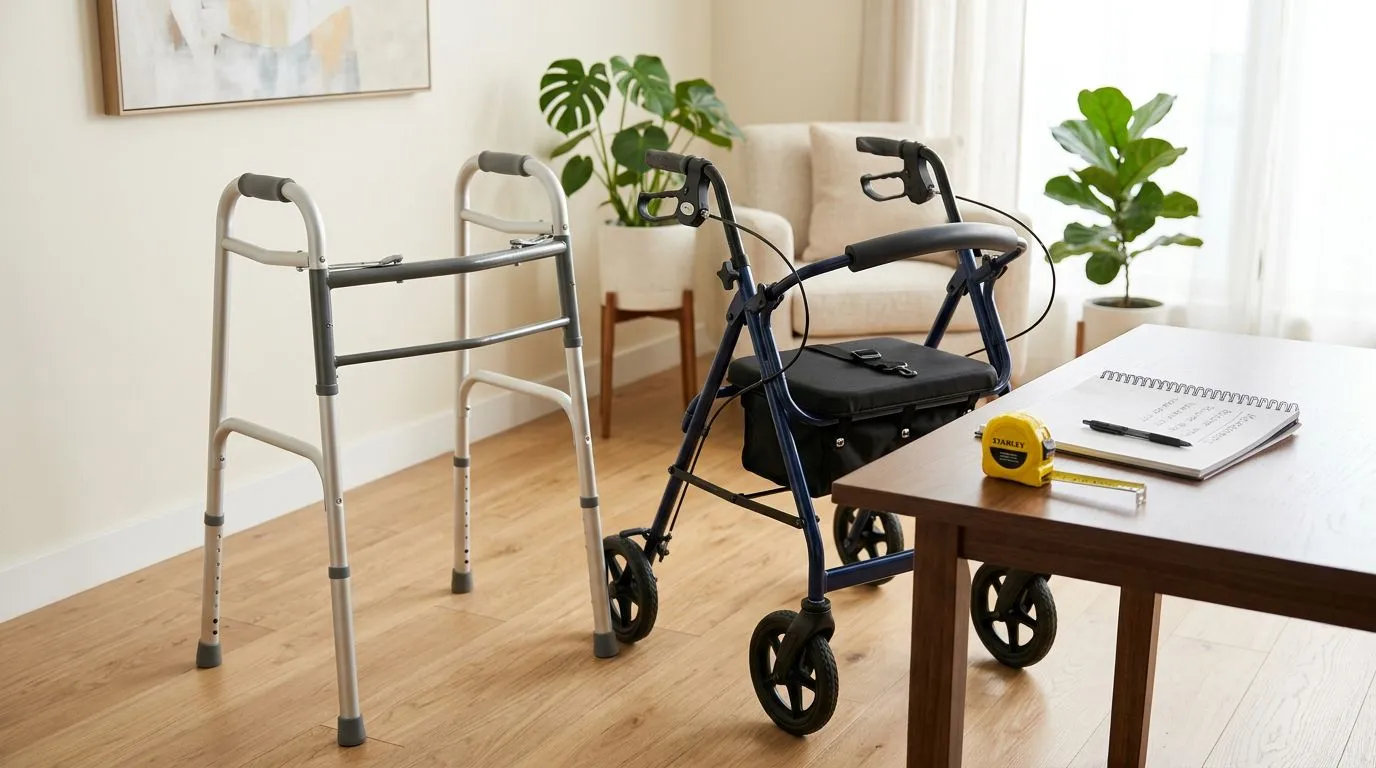
Walkers and rollators can both feel unstable, but they tend to fail in different ways. A standard walker or folding walker usually has 4 legs, sometimes with 2 front wheels and 2 rear rubber tips. A rollator has 3 or 4 wheels, hand brakes, and usually a built-in seat; many 4-wheel rollators also include a backrest. Because the designs differ, the first place to check should differ too.
| Device type | Common wobble source | What to check first |
|---|---|---|
| Standard no-wheel walker | Uneven legs or worn rubber tips | All 4 tips should touch the floor evenly |
| Folding walker | Loose crossbar or worn folding latch | Latch should click fully and stay locked |
| Two-wheel walker | Front wheel wear plus rear tip wear | Both wheels should roll straight and both rear tips should match |
| 3-wheel rollator | Narrower stance and wheel alignment | All 3 wheels should sit flat with no frame twist |
| 4-wheel rollator | Brake adjustment, seat stress, or loose axle hardware | Both brakes should hold and the seat area should not flex |
| Upright or bariatric rollator | Higher handles or heavier frame load | Check handle posts, brake cables, seat supports, and rated capacity |
A walker is usually chosen when someone needs a very stable base and can safely lift or advance the frame. A rollator is often chosen when someone walks longer distances, needs a seat for rest breaks, and can control hand brakes. If your rollator feels wobbly because you are using it like a full body support device, the issue may be fit rather than simple hardware.
Loose fasteners and height pins: check all 4 corners first
Many wobbles begin with a small part that has worked loose over weeks or months. On walkers, look at height adjustment buttons, side braces, crossbars, front wheel attachments, and the folding mechanism. On rollators, check handle posts, brake lever clamps, wheel axles, seat brackets, backrest supports, and any knobs used for folding or height adjustment.
Height buttons should protrude fully through matching holes. If one leg is set 1 hole higher or lower than the others, a standard walker can rock even when nothing is broken. On many adjustable walkers, each height hole changes the handle height by about 1 inch. That small difference can make one tip or wheel carry too much weight.
- Confirm both left legs match both right legs on a standard or folding walker.
- On a two-wheel walker, check that both front wheels are mounted at the same height.
- On a rollator, make sure both handle posts are set to the same marked height.
- Tighten only the parts meant to be user-adjustable; do not force stripped threads.
A clicking sound can point to a loose bracket, but a silent wobble can be just as serious. If a screw spins without tightening, a bolt is missing, or a plastic adjustment collar is cracked, that part should be repaired or replaced before use. Tape, string, or improvised padding is not a safe substitute for a locking pin or structural fastener.
Rubber tips, wheels, and brakes: inspect the 1-inch contact points
The smallest contact points often cause the biggest stability problems. Rubber tips on walkers are typically only about 1 to 1.5 inches across at the bottom. When the tread wears smooth, splits, hardens, or wears at an angle, the walker may slide or rock instead of gripping the floor.
For standard and folding walkers, turn the device sideways or upside down if you can do so safely. Compare all rubber tips. They should be the same style, similar height, firmly seated, and free of holes. If one tip is noticeably shorter, the walker may feel wobbly even on a flat surface. Replace tips as a set when wear is uneven, especially if the walker has been used outdoors on concrete.
For two-wheel walkers and rollators, give the wheels the same attention. A flat-spotted wheel may bump once every rotation. A loose axle may let the wheel lean. Hair, thread, pet fur, or carpet fibers wrapped around the axle can make one wheel drag, which may feel as if the whole device is pulling to one side.
| Part | Warning sign | Practical next step |
|---|---|---|
| Walker rubber tip | Smooth, cracked, angled, or loose | Replace with the correct diameter and matching style |
| Front wheel on two-wheel walker | Wobbles side to side or drags | Check axle hardware and remove wrapped debris |
| Rollator wheel | Uneven rolling or visible lean | Inspect axle, fork, tread, and frame alignment |
| Hand brake | Wheel moves when brake is locked | Stop use until brakes are adjusted or repaired |
| Brake cable | Frayed, kinked, or very loose | Have it serviced rather than guessing at cable tension |
Rollator brakes are not optional safety features. They should slow the device while walking and lock the wheels when sitting. If one brake grabs hard and the other barely works, the rollator can twist or pivot unexpectedly. That is especially risky when turning, sitting down, or standing up from the seat.
Frame, folding latch, and seat stress: take 1 crack seriously
A bent frame is a stop sign. One visible crack, one separated weld, or one latch that will not stay locked is enough reason to stop using the device until it is inspected. Walkers and rollators are designed to carry weight through specific tubes, joints, and braces. Once those parts are bent or cracked, the device may not fail gradually.
Folding walkers can loosen at the hinge points or cross brace. When unfolded, both sides should open evenly and the latch should engage fully. If the walker folds a little when you press down, the latch may be worn, dirty, damaged, or not seated. Do not assume it is safe because it locks sometimes.
Rollators add another stress point: the seat area. The seat is convenient for rest breaks, but it also transfers body weight through brackets, hinges, side rails, and the main frame. Look under the seat for loose screws, stretched fabric, cracked plastic, bent support bars, or movement where the seat attaches. If the rollator has a backrest, check the backrest posts and mounting points too.
Upright rollators and bariatric rollators may use stronger or taller frames, but they still need careful inspection. Taller forearm supports can magnify looseness at the handle post. Higher weight capacities do not mean the device can safely handle side-loading, curb drops, sitting down hard, or being used after a collision with a doorway or car trunk.
- Do not sit on a rollator unless the brakes are locked and the surface is level.
- Do not use a walker or rollator with a visibly bent leg, fork, or side rail.
- Do not keep using a device that changed shape after a fall, car trip, or curb impact.
How to measure height and fit in 3 steps
A walker or rollator can feel wobbly even when the frame is intact if the height is wrong. Too low may make you lean forward and overload the front tips or wheels. Too high may raise your shoulders, reduce control, and make the device feel tippy during turns. A common starting point is handle height near the wrist crease when standing upright in supportive shoes with arms relaxed at your sides.
Use these 3 steps for a basic fit check. First, stand in the shoes you normally wear while walking. Second, adjust both handles or all walker legs evenly. Third, place your hands on the grips; your elbows should have a slight bend, often around 15 to 30 degrees, rather than being locked straight or deeply bent.
For standard walkers, all 4 legs must remain even after adjustment. For two-wheel walkers, the front wheel height and rear leg height must work together so the frame sits level. For rollators, handle height affects brake reach as well as posture. You should be able to wrap your fingers around the brake levers without stretching, twisting your wrists, or letting go of the grips.
Width matters too. A narrow walker may not give enough room for a comfortable step pattern, while a very wide rollator may catch door frames. Many interior US doorways are about 30 to 32 inches wide, though older homes and bathrooms can be tighter. Measure the places you actually use: bathroom doorway, bedroom path, kitchen turns, elevator, car trunk, and the space beside your favorite chair.
Who is best served by each choice in 5 common situations
After a wobble scare, it is worth asking whether the device type still matches the person using it. This is not about upgrading for the sake of it. It is about matching support, control, brakes, seating needs, and walking environment.
| Situation | Often better fit | Why it may help |
|---|---|---|
| Needs maximum steady support indoors | Standard or folding walker | Four tips provide a stable base when used correctly |
| Can walk but struggles to lift a frame | Two-wheel walker | Front wheels reduce lifting while rear tips add friction |
| Needs frequent seated rest breaks | 4-wheel rollator | Built-in seat and brakes support planned pauses |
| Uses tight indoor spaces | Standard walker or compact 3-wheel rollator | Smaller turning space may be easier, depending on balance |
| Needs a more upright posture cue | Upright rollator, if clinically appropriate | Forearm supports may help positioning but require brake control |
A rollator is not automatically safer because it has more features. Its wheels keep moving unless controlled, and its seat should be used only with locked brakes on level ground. A standard walker is not automatically safer either; it must be lifted or advanced correctly, and worn tips can slide. If there has been a recent fall, sudden weakness, dizziness, or a major change in walking ability, ask a healthcare professional or physical therapist for guidance.
Repair, replace, or get help within 24 hours
Some fixes are simple. Replacing worn rubber tips with the correct size, cleaning wheel axles, resetting height buttons evenly, or tightening an approved adjustment knob may solve a minor wobble. Other problems should not wait. If the device cannot support weight predictably today, it should not be used for tomorrow morning's bathroom trip.
Use this practical rule: if the problem involves a wear part, such as tips or wheels, repair may be reasonable if the frame is straight and the correct replacement part is available. If the problem involves the structure, such as a bent tube, cracked weld, folding latch failure, seat support damage, or brake failure on a rollator, get professional help or replace the device. A mobility aid is safety equipment, not ordinary furniture.
- Repair may be reasonable: worn tips, dirty wheels, loose user-adjustable knobs, uneven height settings.
- Get help before use: stripped bolts, brake imbalance, loose axles, latch that does not lock every time.
- Stop using: bent frame, cracked tubing, broken seat support, missing structural fastener, brakes that will not hold.
Care routines help prevent surprises. Check rubber tips and wheels monthly, and sooner if the device is used outdoors every day. Test rollator brakes before each walk by squeezing and locking them on a flat surface. Look over folding latches after every car trip because loading and unloading can bump the frame. If more than one person uses the same device, recheck height and brakes each time it changes users.
The bottom line is simple: a wobbly walker or rollator is trying to tell you something. Start with the contact points, height settings, fasteners, latches, frame, seat area, and brakes. Fix only what can be corrected safely, and take the device out of service when the structure or braking system is in doubt.
FAQ
Frequently asked questions
Is it normal for a folding walker to have a little movement? +
A small amount of play can be normal in some folding frames, but it should not rock, twist, collapse, or change shape under body weight. If the folding latch does not lock fully every time, stop using it until it is inspected.
Can worn rubber tips make a walker feel wobbly? +
Yes. Rubber tips that are smooth, cracked, angled, loose, or uneven in height can make a walker rock or slide. Replace tips with the correct diameter and matching style, often as a full set if wear is uneven.
Why does my rollator pull to one side? +
Common causes include uneven brake tension, a dragging wheel, debris wrapped around an axle, a loose wheel fork, or a bent frame. Check wheels and brakes on a flat surface, and do not use the rollator if the brakes cannot hold evenly.
Should I tighten every screw on a wobbly walker or rollator? +
Only tighten parts meant to be user-adjustable or routine hardware you can clearly identify. Do not force stripped threads, substitute missing bolts, or tape structural parts together. Structural or brake-related problems need proper repair.
When should I replace a walker or rollator instead of repairing it? +
Replacement or professional evaluation is the safer choice if the frame is bent, tubing is cracked, a weld is separated, a folding latch fails, a rollator seat support is damaged, or brakes will not reliably stop and lock the wheels.
Keep reading
Related guides

How to Stop a Walker or Rollator From Squeaking, Rattling, or Feeling Loose
12 min read
Walker and Rollator Maintenance Checklist: Weekly, Monthly, and Before Trips
13 min read
Can a Mobility Walker or Rollator Be Repaired? DIY Fixes, Replacement Parts, and When to Get Service
14 min read