Disclosure: We may earn a commission when you buy through links on this page, at no extra cost to you. We buy nothing, sell nothing and accept no payment for coverage — commissions never decide what we recommend. How we make money.

A walker or rollator should be rated above the user’s actual body weight, not right at it. A practical safety margin is usually at least 20 to 30 pounds, and more if the person leans heavily, carries items, transfers weight onto the frame, or uses the device outdoors.
Weight capacity is only one part of a safe fit. A 400-pound-rated walker that is too narrow, too tall, unstable on turns, or difficult to brake may be less appropriate than a correctly fitted heavy-duty option with the right width, handle height, and everyday usability.
Weight capacity basics: 250 to 500+ lb ratings
Most standard adult walkers and rollators are commonly rated around 250 to 300 pounds, while heavy-duty and bariatric options often range from about 350 to 500 pounds or more. The rating is the manufacturer’s stated maximum user weight under normal use. It is not a suggestion to use the device right up to the limit every day.
For walkers, this rating reflects the frame’s ability to support downward force while the user steps, pauses, or leans briefly. Standard walkers, folding walkers, and two-wheel walkers may look simple, but their tubing, cross-braces, hand grips, height pins, and rubber tips all contribute to the overall support rating.
For rollators, capacity is more complex because the device has wheels, hand brakes, a seat, and often a storage pouch or basket. The stated weight capacity usually refers to the person using the rollator and sitting on its built-in seat. The bag or basket may have a separate limit, often much lower, such as 10 to 20 pounds. Overloading storage can affect steering and balance.
It also helps to remember that a static number does not capture every real-life force. A person who weighs 275 pounds may place more than 275 pounds of momentary pressure on a walker during a stumble, a curb approach, or a sit-to-stand movement. That is why a margin matters.
| Device type | Common capacity range | What to watch |
|---|---|---|
| Standard no-wheel walker | Often 250 to 350 lb | Tip condition, frame width, folding locks |
| Two-wheel walker | Often 250 to 350 lb | Front wheel size, rear tips, control on turns |
| 3-wheel rollator | Often 250 to 300 lb | No seat on many designs, narrower base, turning stability |
| 4-wheel rollator with seat | Often 250 to 400 lb | Brake strength, seat width, wheel size |
| Bariatric walker or rollator | Often 350 to 500+ lb | Overall width, product weight, doorway clearance |
Safety margin: why 20 to 30 lb is a minimum
A good starting rule is to choose a walker or rollator with at least 20 to 30 pounds of capacity above the user’s current weight. For example, a person who weighs 270 pounds should generally avoid a device rated for exactly 275 pounds and look for a higher capacity category instead.
That margin is not about fear. It is about ordinary use. People may wear heavier clothing, carry groceries, place a purse or oxygen supplies on the frame, or put extra downward pressure through the handles when tired. Body weight can also change by 5 to 15 pounds over time due to fluid shifts, medication changes, seasonal habits, or recovery after illness.
A larger buffer is wise when the person relies on the device for significant weight support rather than light balance. A walker used after surgery, during rehabilitation, or by someone with weakness on one side may experience more force than a walker used mainly for steadiness in the hallway.
Rollators deserve special caution. Many people sit on the built-in seat several times a day, which places weight directly onto the frame, seat panel, hinges, and wheelbase. If a rollator is rated for 300 pounds and the user weighs 298 pounds, there is essentially no room for dynamic force, clothing, or carried items.
A simple margin guide
| User situation | Suggested capacity buffer | Why |
|---|---|---|
| Light balance support indoors | At least 20 to 30 lb | Allows for daily variation and normal pressure |
| Frequent leaning or fatigue | At least 40 to 75 lb | Handles may take more downward force |
| Outdoor use, slopes, or uneven surfaces | At least 50 lb or more | Dynamic forces increase on rough ground |
| Rollator used for sitting daily | At least 50 lb or more | Seat, brakes, and frame all carry load |
| Weight near the standard limit | Move to heavy-duty sizing | Better fit may require stronger tubing and wider stance |
Walkers vs rollators: 0, 2, 3, or 4 wheels changes the decision
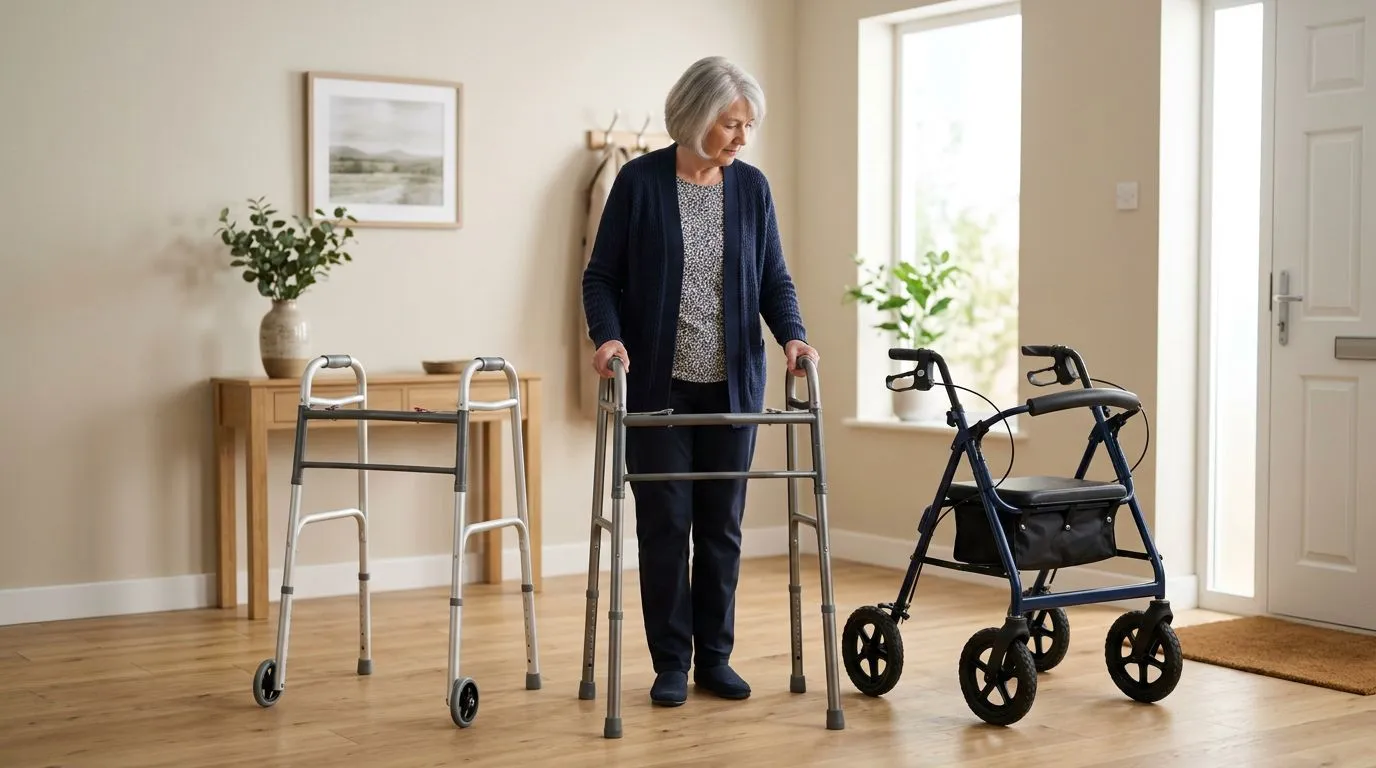
Walkers and rollators are related, but they are not the same tool. A walker is usually a more stable support frame, often with no wheels or with 2 front wheels. A rollator is a wheeled walker with hand brakes, typically 3 or 4 wheels, and most 4-wheel models include a built-in seat.
A no-wheel standard walker offers the most controlled stop because it does not roll unless the user lifts it. That can help someone who needs firm support with each step. The tradeoff is effort: lifting a walker hundreds of times per day can be tiring, especially if the frame is heavy-duty.
A two-wheel walker reduces lifting because the front legs roll while the rear tips slide or step. It can be a good middle ground for people who need more stability than a rollator but less lifting than a standard walker. Weight capacity still matters, and the rear tips should be inspected because worn tips can reduce control.
A 3-wheel rollator is usually easier to maneuver in tight spaces and may turn within a smaller radius than a 4-wheel design. Many 3-wheel rollators do not have a seat, and their triangular base can feel less stable for some users, especially at higher body weights or on uneven outdoor surfaces.
A 4-wheel rollator provides continuous rolling movement, a seat, and hand brakes. It can be excellent for people who can walk fairly well but need balance support and rest breaks every few hundred feet. It is usually not the best choice for someone who must put substantial body weight through the handles with every step, because rollators can move if braking technique is poor or brakes are not adjusted.
| Type | Best for | Capacity concern | Stability note |
|---|---|---|---|
| No-wheel walker | Maximum step-by-step control | Frame and tip wear | Very stable when placed flat |
| Two-wheel walker | Indoor walking with less lifting | Rear tips and front wheel mounts | Stable, but moves forward more easily |
| 3-wheel rollator | Tight spaces and lighter support | Often lower capacity and no seat | Less forgiving than 4 wheels for some users |
| 4-wheel rollator | Walking distance with rest breaks | Seat, brakes, and wheelbase | Stable when brakes are used correctly |
| Upright rollator | More upright posture support | Forearm platform and frame rating | Requires careful fit and braking comfort |
Bariatric sizing: 22 to 30 inch widths matter as much as pounds
Bariatric walkers and rollators are not just standard devices with a higher number printed on the label. They are often wider, made with heavier tubing, and built with reinforced frames. Seat widths on heavy-duty rollators may be around 18 to 24 inches, while overall device width can reach roughly 26 to 30 inches or more.
That extra width can improve comfort and stability, but it can also create practical problems. Many interior doorways in older homes are about 28 to 30 inches wide, and bathroom doors can be narrower. A bariatric rollator that is 29 inches wide may fit through the front door but not into the bathroom. Measure the actual home environment before buying.
Seat fit is especially important for rollators. The seat should be wide enough for the user to sit without squeezing against the side supports, but not so wide that the rollator becomes hard to control. Seat height matters too. Common rollator seat heights are often around 20 to 24 inches, but the right height depends on leg length and how easily the person can stand back up.
For walkers, the inside width between the handles and rear legs matters. A user should be able to step into the frame without bumping the sides. If the walker is too narrow, posture may become awkward and the person may walk behind the frame instead of inside it, reducing safety.
Heavy-duty devices can also weigh more. A standard folding walker may weigh under 10 pounds, while a bariatric rollator may weigh 20 pounds or more. If the user or caregiver must lift it into a car trunk twice a day, device weight becomes part of the safety equation.
How to choose and measure: 5 checks before you buy
Choosing by weight capacity alone is a common mistake. Use these 5 checks together: user weight, handle height, body width, doorway clearance, and daily terrain. If any one of these is wrong, even the highest-rated frame may still be a poor fit.
1. Confirm current user weight
Use a recent, realistic weight, not an estimate from last year. Add a minimum buffer of 20 to 30 pounds, and consider 50 pounds or more if the person leans hard on the device, uses a rollator seat often, or walks outdoors.
2. Measure handle height
For most walkers and rollators, handles are adjusted near wrist height when the user stands upright with arms relaxed at the sides and regular shoes on. The elbows should bend slightly, often about 15 to 30 degrees, when holding the grips. Handles that are too low encourage stooping; handles that are too high can reduce control.
3. Check body and seat width
For walkers, confirm the user can stand inside the frame and take a normal step. For rollators, measure hip width while seated and compare it with the usable seat width, not just the outside frame width. A seat that feels cramped may discourage safe resting.
4. Measure the narrowest doorway
Measure bathroom, bedroom, hallway, and elevator openings. A device that clears a 32-inch front door may still fail at a 24-inch bathroom door. Leave some room for hands on the grips and for imperfect steering.
5. Match wheels and brakes to the environment
Rollator wheels commonly range from about 6 to 10 inches. Larger wheels generally handle sidewalk cracks and thresholds better, while smaller wheels may be easier indoors. Hand brakes should be easy to squeeze and lock; weak hands, arthritis, or numbness can make brake style and adjustment very important.
Who it is best for: 3 common user profiles
The best weight capacity depends on how the device is used, not just what the scale says. These 3 common examples show why two people at the same weight may need different choices.
The indoor balance user
A person who weighs 190 pounds, walks mainly inside a one-level home, and uses the frame for light steadiness may do well with a standard walker or standard rollator rated well above that weight. The focus should be handle height, easy folding, and safe movement through hallways.
The frequent rester
A person who weighs 260 pounds and needs to sit every 5 to 10 minutes may need a rollator with a higher capacity, a comfortable seat width, and dependable locking brakes. The seat rating and brake performance are just as important as the frame rating.
The high-support user
A person who weighs 315 pounds and places significant pressure through the arms may be better served by a heavy-duty walker or bariatric rollator rated well above 350 pounds, depending on walking ability and clinical guidance. If balance is poor or the person cannot control a rolling device, a walker may be safer than a rollator.
When there is doubt, ask a physical therapist, occupational therapist, physician, or durable medical equipment professional to assess gait, strength, home layout, and transfer safety. A short in-person fitting can prevent a long list of daily frustrations.
Daily use factors: 10 lb bags, curbs, cars, and carpet
Real life is harder on mobility equipment than a showroom floor. A walker or rollator may be used on carpet, tile, porch steps, sidewalk seams, ramps, gravel driveways, and parking lots. Each surface changes the forces on the frame.
Carrying items is another overlooked issue. A rollator storage pouch with 15 pounds of groceries can affect steering, especially if the weight hangs forward or to one side. A walker basket or bag may seem harmless, but uneven weight can make the frame twist during turns.
Transfers deserve special care. A walker is not a grab bar, and a rollator should not roll during sitting or standing. If a person pushes down hard on one handle while rising from a chair, the device can tip or move. Rollator brakes should be locked before sitting, and users should turn fully, back up until they feel the seat behind the legs, and sit with control.
Transport matters too. A heavy-duty rollator that folds to a manageable shape may still be too heavy for a caregiver to lift safely. If the device must go in and out of a vehicle 4 times a week, check folded dimensions and lifting weight before deciding.
Warning signs: 6 reasons a higher capacity device may be needed
Replace or reassess a walker or rollator if it shows signs of overload, poor fit, or unsafe handling. Do not wait for a fall or frame failure to take action.
- The frame flexes, twists, or creaks during normal use.
- Height adjustment buttons, folding locks, or cross braces feel loose.
- Rollator brakes do not hold the wheels firmly when locked.
- The user avoids sitting because the rollator seat feels narrow or unstable.
- The user walks outside the walker frame instead of inside it.
- Rubber tips, wheels, or hand grips wear out in less than a few months.
These signs do not always mean the capacity rating is too low, but they do mean the setup needs attention. Sometimes the solution is a higher-rated bariatric frame. Other times, it is new walker tips, brake adjustment, a different handle height, or a device type that better matches the person’s gait.
Bottom line: choose capacity plus fit, with at least 20 lb to spare
For most people, a walker or rollator should have at least 20 to 30 pounds of weight capacity beyond current body weight. A larger buffer is smart when the user leans heavily, sits on a rollator often, uses the device outdoors, or is close to the top of a standard rating category.
Still, the safest choice is not always the highest number. The right mobility aid must fit through the home, match the user’s hand strength and walking pattern, provide enough width without becoming unwieldy, and feel stable during ordinary routines. Weight capacity starts the conversation; fit and daily use finish it.
FAQ
Frequently asked questions
How much extra weight capacity should a walker have? +
A walker should usually be rated at least 20 to 30 pounds above the user’s current body weight. Consider a larger margin, such as 50 pounds or more, if the person leans heavily on the walker, uses it outdoors, or is near the upper end of a standard weight rating.
Is a bariatric walker safer for everyone? +
Not always. Bariatric walkers can provide higher weight capacity and a wider frame, but they may also be heavier and harder to maneuver through narrow doors. The safest choice is the one that fits the user’s weight, body width, strength, home layout, and walking needs.
Does rollator weight capacity include sitting on the seat? +
In most cases, the main rollator weight capacity applies to the user and includes sitting on the built-in seat. Storage bags or baskets may have separate, much lower limits, so avoid loading them with heavy items unless the instructions allow it.
Can I use a rollator if I need to put a lot of weight on the handles? +
A rollator may not be the best choice for heavy weight-bearing because it has wheels and can move if the brakes are not used correctly. People who need firm support with each step may be safer with a standard walker or two-wheel walker, depending on professional guidance.
What matters besides walker or rollator weight limit? +
Important factors include handle height, overall width, inside frame width, seat width on rollators, brake strength, wheel size, folded size, device weight, and where it will be used. A high capacity rating does not make up for poor fit or difficult handling.
Keep reading
Related guides
Heavy-Duty Walkers and Bariatric Rollators: What Higher Weight Capacity Adds to the Price
14 min read
Heavy-Duty Rollator Walkers: Weight Capacity, Seat Width, Frame Strength, and Stability Basics
14 min read
Lightweight Mobility Walkers: Balancing Easy Lifting, Stability, and Weight Capacity
14 min read