Disclosure: We may earn a commission when you buy through links on this page, at no extra cost to you. We buy nothing, sell nothing and accept no payment for coverage — commissions never decide what we recommend. How we make money.
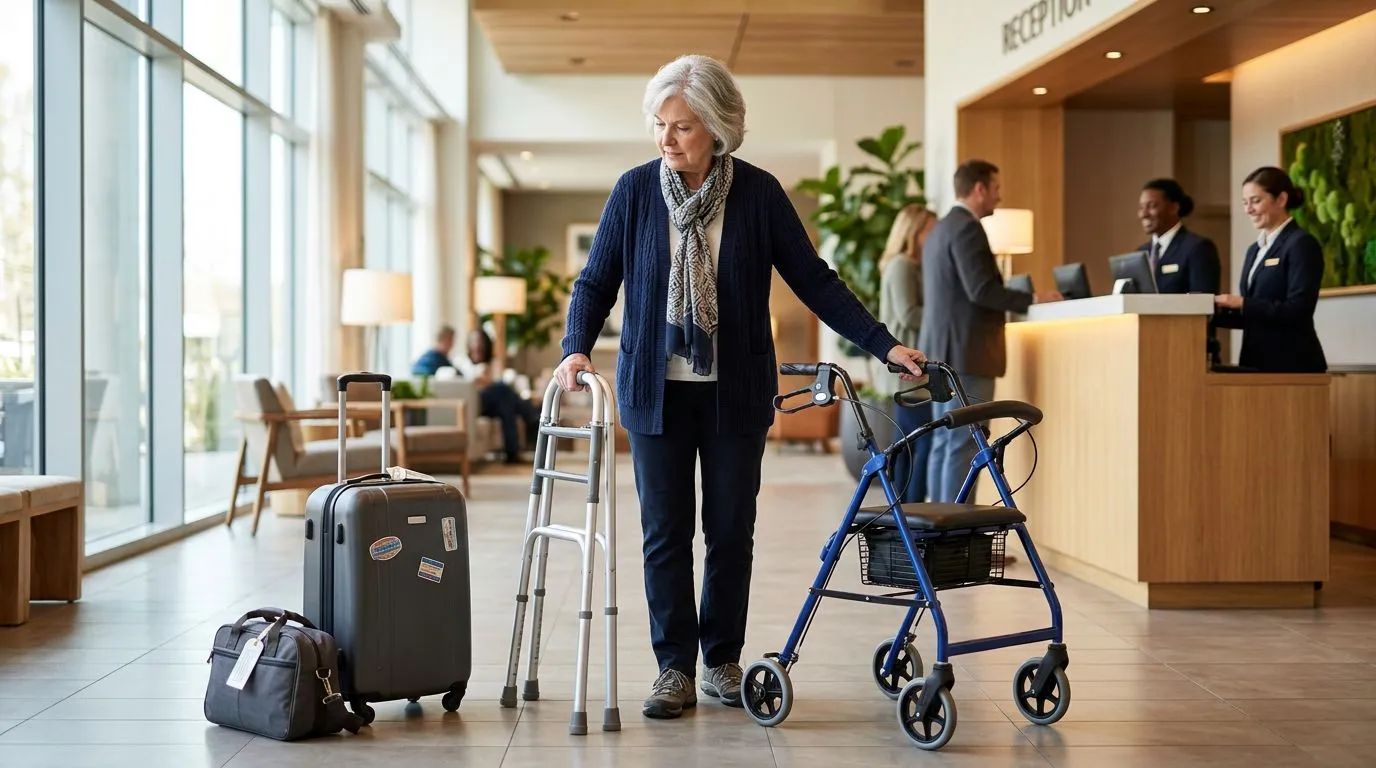
For most U.S. trips, bring your own folding walker or rollator if you rely on a specific fit, brake feel, seat height, or accessory setup. Rent a walker or rollator at your destination if you are flying with limited luggage, recovering temporarily, or need delivery to a hotel, rental home, cruise port, or family address.
Before reserving anything, confirm the exact mobility aid type, user height and weight, delivery window, total cost, and pickup process in writing. A standard walker and a rollator are not interchangeable, especially if you need a seat, hand brakes, or a no-wheel frame for maximum stability.
Bring or rent: the 3-question travel decision
The quickest way to decide is to ask 3 questions: How much do you depend on your current walker or rollator, how difficult will it be to transport, and how predictable is your destination? If one missed delivery would stop the trip, bringing your own device is usually the safer plan.
A folding walker is often simple to travel with because many fold to roughly 4 to 6 inches deep, depending on the frame. A 4-wheel rollator may fold too, but the seat, wheels, brake cables, and backrest usually make it bulkier in a car trunk or airport shuttle.
Renting makes sense when the trip is short, the destination is accessible, and the rental provider can deliver before arrival. It can also help if you need a temporary upgrade, such as a bariatric rollator with a higher weight capacity or a rollator seat for long museum or resort days.
| Travel situation | Usually better to bring | Usually better to rent |
|---|---|---|
| Daily use at home | Your own properly fitted walker or rollator | Only if an identical type and size is confirmed |
| 2- or 3-day hotel stay | Folding walker if easy to pack | Rollator if you want local delivery and a seat |
| Air travel with connections | Compact folding walker or essential personal device | Backup at destination if provider offers timed delivery |
| Large resort, theme park, or convention | Your own rollator if you trust the brakes and fit | 4-wheel or upright rollator for distance and rest breaks |
| Temporary injury or post-procedure trip | Only if already fitted by a clinician | Short-term standard walker or two-wheel walker rental |
Walker versus rollator rentals: 2 different tools
A walker is a frame you lift or partly roll forward for support. A rollator is a wheeled walker with 3 or 4 wheels, hand brakes, and usually a built-in seat. That one difference changes almost everything about travel use.
Standard no-wheel walkers are the most stable but also the slowest because the user lifts the frame with each step. Two-wheel walkers roll at the front and have rear glides or tips, which can help on indoor floors while still giving more control than a full rollator. Folding walkers are popular for travel because they collapse flat and are easier to place in a car, hotel closet, or overhead storage area where permitted.
Rollators are made for smoother walking and rest breaks. A 4-wheel rollator is common for outdoor sidewalks, long hallways, and attractions where the seat matters. A 3-wheel rollator turns in a tighter radius and is often lighter, but it usually does not have the same seated-rest function as a 4-wheel model. Upright or stand-up rollators place the forearm supports higher, which may help some users maintain a more upright posture, but they are larger and must be fitted carefully.
| Type | Typical travel advantage | Watch-outs |
|---|---|---|
| Standard no-wheel walker | High stability; simple frame; often lightweight | Slow on long routes; no seat; must be lifted |
| Two-wheel walker | Easier forward movement indoors | Not for sitting; rear tips can catch on uneven surfaces |
| Folding walker | Often folds flat to a few inches deep | May still be awkward in small rideshare trunks |
| 3-wheel rollator | Narrower turning for shops and hallways | Less stable than 4-wheel designs; seat may be absent or limited |
| 4-wheel rollator | Seat, hand brakes, storage pouch, smoother travel pace | Requires brake control; bulkier when folded |
| Upright rollator | Higher forearm support for selected users | More size-sensitive; harder to transport |
| Bariatric rollator | Higher weight capacity and wider frame | May not fit narrow bathroom doors or small elevators |
Who travel rentals are best for: 5 common examples
Travel rentals work best when convenience matters more than the comfort of using your own equipment. These 5 examples come up often for U.S. travelers.
- The airport minimalist: A traveler who can walk short distances with assistance but needs a walker or rollator once settled at the hotel.
- The short-term recovery traveler: Someone visiting family for 1 to 2 weeks after a sprain, surgery, or medical procedure, with guidance on what device type is appropriate.
- The resort or attraction visitor: A person who normally uses a cane indoors but needs a 4-wheel rollator with a seat for long outdoor paths.
- The caregiver managing luggage: A spouse or adult child who cannot safely handle suitcases, medical bags, and a bulky rollator at the same time.
- The size-specific user: A traveler who needs a bariatric rollator, taller handles, or a wider seat that is difficult to pack from home.
Renting is not ideal for everyone. If your walker is adjusted to the exact inch, your rollator brakes feel familiar, or you have practiced transfers using your own frame, a substitute can feel uncomfortable. That does not mean a rental is unsafe by default, but you should allow time to adjust before your first long outing.
How to choose and measure before you book, using 4 key numbers
Good travel rental fit starts with 4 numbers: user height, user weight, handle height, and the narrowest doorway or path you expect to use. Write them down before you call or reserve online.
For walker and rollator handle height, a common starting point is wrist height when standing upright in supportive shoes with arms relaxed at the sides. When holding the grips, elbows are often slightly bent, around 15 to 30 degrees. This is a general fitting guideline, not a substitute for advice from a physical therapist, occupational therapist, or clinician.
Weight capacity matters. Many standard walkers and rollators have capacities in the range of about 250 to 300 pounds, while bariatric versions may be rated higher. Do not assume a rental frame is appropriate based on appearance; ask for the stated weight capacity and make sure it includes any clothing or carried items that affect load.
Width matters too. Many interior residential doorways are around 28 to 32 inches wide, and older bathrooms can be tighter. A wider bariatric rollator may be comfortable in open hotel corridors but difficult inside a small bathroom or vacation rental bedroom.
- User height: Helps match handle adjustment range.
- User weight: Confirms frame and seat capacity.
- Handle height: Helps avoid stooping or shoulder strain.
- Doorway width: Helps prevent a device that fits the lobby but not the room.
If renting a rollator, also ask about seat height and seat width. A seat that is too low can make standing difficult; a seat that is too narrow may be uncomfortable or unsafe. The user should be able to sit with both feet on the floor and stand using appropriate technique, not by pulling hard on an unlocked frame.
Delivery timing: plan a 2-hour buffer when possible
Delivery is where many travel rental problems happen. A walker that arrives 2 hours late may be a minor inconvenience for one traveler and a trip-stopper for another.
Ask whether the provider delivers to hotels, vacation rentals, private homes, assisted living communities, airports, cruise terminals, or medical facilities. Hotels are often the simplest because the front desk may accept equipment before check-in, but policies vary. Vacation rentals can be trickier if there is no staffed lobby and the entry code is not active until arrival.
Confirm whether the walker or rollator will be delivered assembled and adjusted, or simply dropped off. A standard folding walker may need only height adjustment. A rollator may require the backrest, storage bag, or brake tension to be checked before use. If the user cannot safely adjust equipment, ask whether delivery includes setup.
Build a buffer into the schedule. If check-in is at 4 p.m. and dinner is at 5 p.m., a delayed rollator creates stress. A better plan is to request delivery before arrival, or to leave a 2- to 4-hour window before the first activity that requires walking.
Cost questions: daily, weekly, deposits, and the real total
Walker and rollator rental costs in the U.S. are usually quoted by the day, week, or month, and the lowest daily price is not always the lowest total. Delivery, pickup, deposits, damage waivers, and late-return fees can change the final bill.
As a broad planning range, simple walker rentals may cost less than rollator rentals, while upright and bariatric rollators often cost more because they are larger, heavier, and less common. In many travel markets, a weekly rental can be more economical than paying 5 to 7 separate daily charges. Rates vary widely by city, season, delivery distance, and inventory.
Ask for an itemized quote before you commit. The quote should identify the device type, rental dates, delivery address, pickup address, delivery fee, taxes or local fees, deposit policy, cancellation deadline, and what happens if travel delays change your arrival time.
| Cost item | Question to ask | Why it matters |
|---|---|---|
| Base rental | Is pricing daily, weekly, or monthly? | A 6-day trip may be cheaper as a weekly rental. |
| Delivery | Is delivery included within a set mileage radius? | Remote rentals can cost more than city hotel delivery. |
| Pickup | Is pickup included or billed separately? | Some quotes include drop-off but not return pickup. |
| Deposit | Is a refundable deposit required? | You need to know when and how it is returned. |
| Damage or cleaning | What condition is expected at return? | Beach sand, rain, or missing parts may trigger fees. |
| Late return | What if checkout or pickup changes by 24 hours? | Travel delays happen, especially with flights. |
Return pickup: confirm the last 24 hours
The return process deserves as much attention as delivery. The last 24 hours of a trip are often rushed, and a missed pickup can lead to extra charges or a walker left with the wrong person.
Ask where the device should be left. At a hotel, that may be the bell desk, front desk, or luggage room. At a vacation rental, it may be inside the entry, on a covered porch, or at a property office. Do not leave a rollator outside unless the provider specifically approves it, because rain, theft, or building rules can create problems.
Take 2 quick photos at return: one showing the walker or rollator condition and one showing where it was left. Keep the pickup confirmation until any deposit is refunded. This is especially useful if pickup happens after you leave for the airport.
If your departure is early, ask whether pickup can happen the night before. If you still need support to reach the car or shuttle, plan carefully. Some travelers keep their own cane for short final transfers, but a cane is not a direct substitute for a walker or rollator if that level of support is needed.
Flying with your own walker or rollator: 6 practical points
Many U.S. travelers fly with a walker or rollator rather than renting. Mobility aids are commonly handled differently from regular luggage, but procedures vary by airport, airline, aircraft size, and security conditions.
A folding walker is often easier to manage through security and gate areas than a full-size rollator. A rollator, however, may be essential if the traveler needs a seat while waiting. If you use a rollator to the gate, ask staff how it will be tagged, where it will be returned, and whether any removable bag or accessory should be carried on separately.
- Fold it before the trip: Practice folding and unfolding at least 3 times before travel day.
- Label it: Add name and phone number on the frame, not just on a removable bag.
- Remove loose items: Baskets, cup holders, and pouches can detach during handling.
- Protect brake cables: Rollator brake cables can snag if left exposed.
- Allow extra time: Arrive earlier than usual if walking speed is limited.
- Plan the arrival: Know whether the device comes back at the aircraft door or baggage area.
If the device is damaged in transit, report it before leaving the airport when possible. Take photos and keep any claim documentation. This is one reason some travelers rent at the destination even when they own a rollator: they prefer not to risk damage to a device they use every day.
Hotel, rental home, and attraction access: measure 30 inches before arrival
A mobility aid that works at home can become frustrating in a tight room. Before arrival, ask about step-free entry, elevator access, bathroom layout, and whether main pathways are at least about 30 inches wide.
Hotels may advertise accessible rooms, but features differ. Ask specific questions rather than relying on a general label. Is there a roll-in shower or a tub? How wide is the bathroom door? Is there space to park a walker next to the bed? Can a rollator turn near the toilet? These details affect both safety and convenience.
Vacation rentals vary even more. A listing may show a beautiful one-level home while leaving out a single step at the entry, gravel driveway, raised threshold, or narrow hallway. For a no-wheel walker, uneven outdoor surfaces can be tiring. For a rollator, gravel, thick rugs, and steep ramps can make control harder.
Attractions add another layer. Museums, stadiums, theme parks, casinos, and convention centers may involve long distances, security screening, elevators, ramps, and crowded aisles. A rollator with a seat can be helpful for rest breaks, but only if the user can safely operate the brakes and park out of traffic.
Safety checks on pickup: take 60 seconds before the first walk
Before using a rental walker or rollator, spend 60 seconds checking the basics. Do this before leaving the lobby, rental home, or delivery area.
- Frame: Look for cracks, bent legs, loose crossbars, or missing adjustment buttons.
- Height: Confirm both sides are set evenly at the same hole or marking.
- Tips and wheels: Walker tips should not be worn through; rollator wheels should spin without wobbling.
- Brakes: Rollator hand brakes should slow the wheels and lock for sitting.
- Seat: If present, check that it is secure and appropriate for the user’s weight capacity.
- Fold lock: Make sure the walker or rollator stays open during use.
Never sit on a standard walker or two-wheel walker. Only sit on a rollator designed with a seat, and lock the brakes first. If anything feels unstable, stop and call the provider before using it for a long outing.
Best rental choice by trip type: 4 examples
The right device depends on the trip. A 1-night family visit is different from a 10-day sightseeing vacation.
For a hotel-based medical visit, a standard folding walker or two-wheel walker may be enough if the main need is short, controlled movement between the car, room, and clinic. For a city sightseeing trip with long sidewalks, a 4-wheel rollator may be more practical because it supports a smoother pace and offers a seat for breaks.
For tight indoor spaces, a narrow walker or 3-wheel rollator may be easier to maneuver, but stability needs come first. For larger users, a bariatric walker or bariatric rollator should be requested by weight capacity and width, not just by name. For posture-specific needs, an upright rollator may be worth asking about, though availability can be limited and fit is more sensitive.
| Trip type | Consider first | Why |
|---|---|---|
| Short family visit | Folding walker or two-wheel walker | Simple, compact, and practical for indoor use |
| Resort or cruise-area stay | 4-wheel rollator | Seat and storage help during long days |
| Small apartment or older home | Narrow walker or compact rollator | Doorways and bathrooms may be tight |
| Higher weight-capacity need | Bariatric walker or rollator | Frame, seat, and width must match the user |
The best rental is not the fanciest one. It is the one that fits the person, the destination, and the walking plan for the next few days.
Reservation checklist: 12 details to confirm in writing
Use this 12-point checklist before paying for a travel walker or rollator rental. A short email or text confirmation can prevent most misunderstandings.
- Exact device type: standard walker, folding walker, two-wheel walker, 3-wheel rollator, 4-wheel rollator, upright rollator, or bariatric option.
- User height and handle-height adjustment range.
- User weight and stated weight capacity.
- Seat height, seat width, and seat capacity if renting a rollator.
- Overall width of the device, especially for bathrooms and narrow doors.
- Folded size if it must fit in a car trunk.
- Delivery address, date, and time window.
- Whether setup and height adjustment are included.
- Total cost, including delivery, pickup, taxes, deposits, and late fees.
- Cancellation or change deadline.
- Return location and pickup window.
- After-hours phone number for delivery problems or equipment concerns.
If a provider cannot answer basic fit and return questions, keep looking. Travel already has enough uncertainty; your mobility support should be one of the predictable parts of the trip.
FAQ
Frequently asked questions
Is it better to bring my own walker or rent one when traveling? +
Bring your own walker if you rely on its exact fit, use it daily, or cannot risk a delivery problem. Renting can be easier for short trips, hotel stays, or temporary needs when the provider can confirm the right type, size, delivery time, and return pickup.
Can I rent a rollator with a seat for a hotel stay? +
Often, yes. Many mobility rental providers deliver 4-wheel rollators to hotels, but you should confirm the seat height, seat width, weight capacity, delivery window, and whether the hotel will accept the rollator before you arrive.
What measurements do I need before renting a walker or rollator? +
Have the user’s height, weight, approximate handle height, and the narrowest doorway or bathroom width at the destination. For rollators, also ask about seat height, seat width, overall frame width, and folded size if it must fit in a vehicle.
How much does it cost to rent a walker or rollator in the U.S.? +
Costs vary by city, device type, rental length, delivery distance, and fees. Simple walkers usually cost less than rollators, while upright and bariatric rollators often cost more. Always ask for the total including delivery, pickup, deposit, taxes, and late-return fees.
Can I fly with my own walker or rollator instead of renting? +
Yes, many travelers fly with their own walker or rollator. Practice folding it, label the frame, remove loose accessories, and ask airline or airport staff how it will be handled and where it will be returned after the flight.
What should I check when a rental walker or rollator is delivered? +
Check that the frame is stable, the height is even on both sides, wheels or tips are in good condition, folding locks work, and rollator brakes lock securely. If the device has a seat, confirm it is designed for sitting and matches the stated weight capacity.
Keep reading
Related guides

Renting vs Buying a Walker or Rollator in the US: Short-Term Recovery, Travel, and Long-Term Use
16 min read
Using a Walker or Rollator in Hotels and Vacation Rentals: A Practical Lodging Checklist
13 min read
Where to Buy a Mobility Walker in the U.S.: Local DME Suppliers, Retail Stores, and Online Options
14 min read