Disclosure: We may earn a commission when you buy through links on this page, at no extra cost to you. We buy nothing, sell nothing and accept no payment for coverage — commissions never decide what we recommend. How we make money.
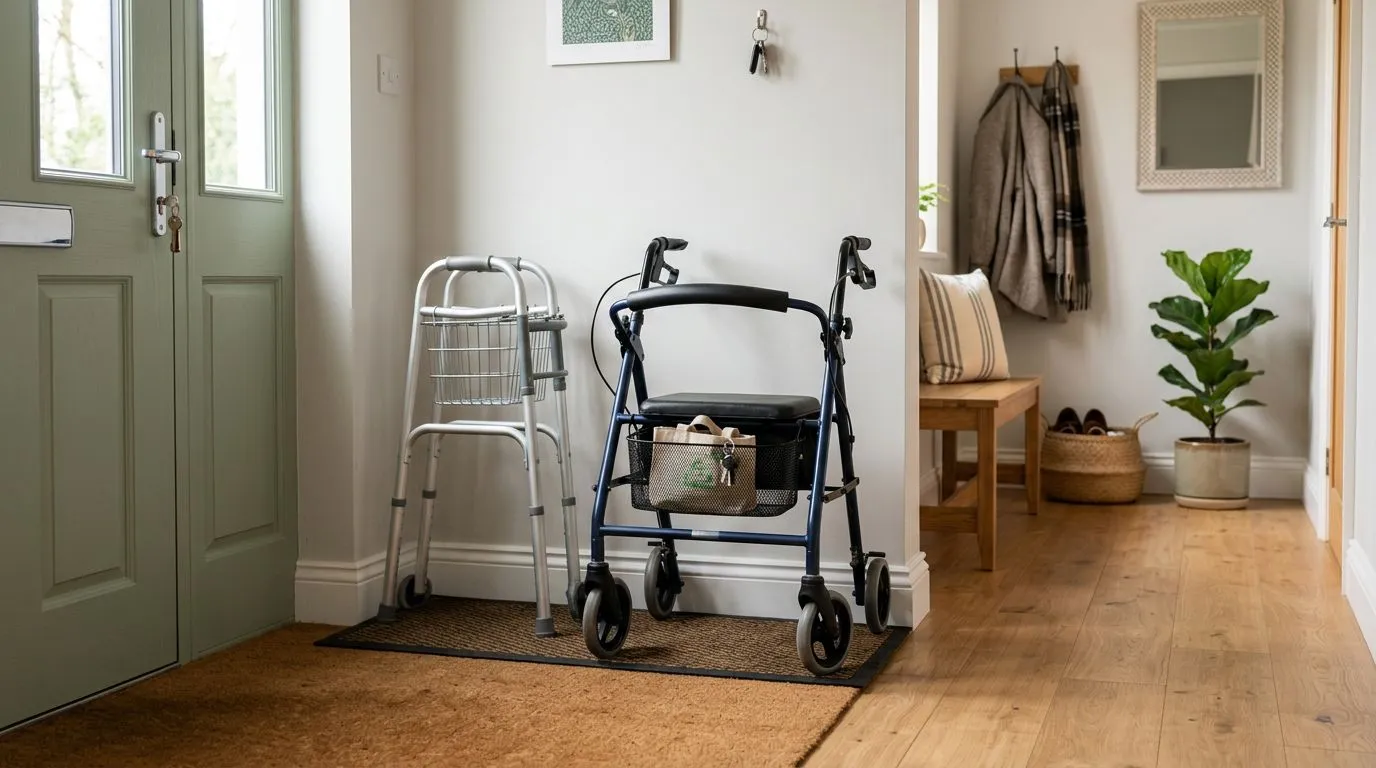
To store a walker or rollator safely, wipe it dry, remove dirt from the feet or wheels, fold it without forcing the frame, and keep it in a dry place away from direct heat, concrete moisture, and heavy objects. Rollators need extra care because damp storage, trunk heat, or pressure on the frame can damage hand brakes, cables, seats, and wheel bearings.
A standard walker or two-wheel walker is usually easier to store than a rollator because it has fewer moving parts. A rollator, especially a 4-wheel model with a seat and hand brakes, should be stored upright or folded according to its frame design, with the brakes released unless the manufacturer’s instructions say otherwise.
A 5-minute storage routine that prevents most problems
Most rust, sticking brakes, and bent frames start with small habits: putting a damp walker in a garage, folding a rollator with the basket stuffed full, or laying a frame under heavy items in the trunk. A simple 5-minute routine before storage can prevent many of these problems.
- Wipe moisture off the frame. Use a dry towel on aluminum or steel tubing, joints, screws, wheel forks, and brake hardware.
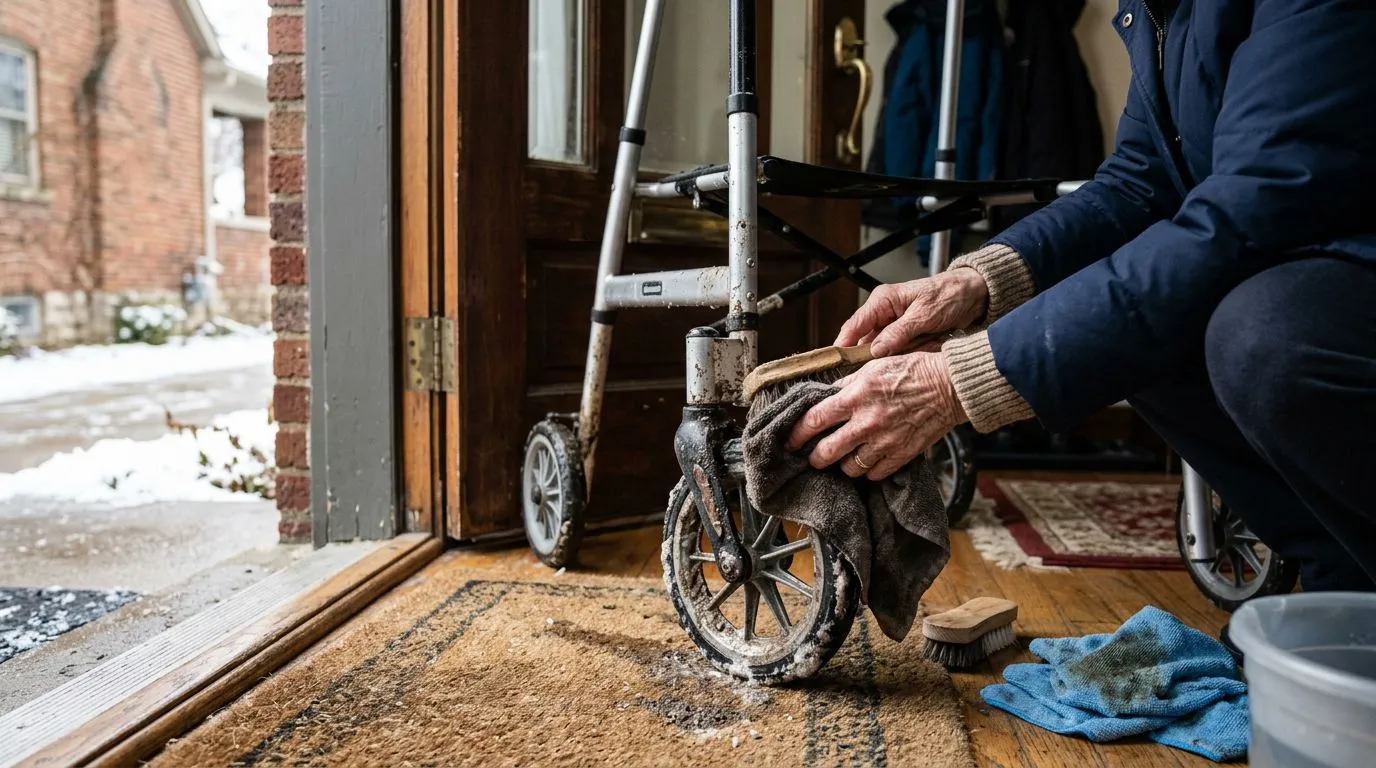
- Clean the contact points. For walkers, check rubber tips, rear glides, and front wheels. For rollators, remove hair, leaves, grit, and road salt from all 3 or 4 wheels.
- Empty storage areas. Take weight out of rollator baskets, pouches, and under-seat bags before folding or storing.
- Fold only along the normal hinge path. If a folding walker or rollator resists, stop and look for a stuck latch, a twisted pouch, or a brake cable caught in the frame.
- Store it where air can move. Avoid sealing a damp walker or rollator in a plastic bag for days at a time.
That short routine helps both walkers and rollators, though the risks differ. A walker frame is most likely to develop rust around fasteners or damage to rubber tips. A rollator is more likely to develop brake cable stiffness, wheel squeaking, seat warping, or misalignment if it is stored under pressure.
Why rust, warping, and brake trouble start during 24 to 48 hours of poor storage
A walker may look dry from a distance while moisture remains inside hinge areas, around screws, or under rubber hand grips. After 24 to 48 hours in a damp corner, especially after rain or snow exposure, those small wet areas can start corrosion on metal hardware. Aluminum frames resist rust better than bare steel, but screws, axles, brake parts, and fasteners may still corrode.
Warping is usually caused by pressure and heat. If a folding walker is stored half-latched under a heavy box, the side frames may no longer open evenly. If a rollator is left in a hot trunk with weight pressing on the seat, backrest, or brake handles, plastic parts and padded surfaces may lose shape.
Brake problems are mainly a rollator concern. Most standard walkers and two-wheel walkers do not have hand brakes. Rollators usually have loop-style hand brakes connected to the rear wheels by cables or rods. Dirt, moisture, cable kinks, and prolonged pressure on the brake handles can all interfere with smooth braking. A brake that feels stiff, weak, or uneven after storage should be adjusted or inspected before regular use.
Best indoor storage spots for walkers and rollators in a 30-inch pathway
Indoor storage is usually the safest option. A walker or rollator kept in a dry hallway, bedroom corner, mudroom, or closet is less exposed to humidity, freezing temperatures, and trunk heat. The key is keeping the mobility aid accessible without turning it into a trip hazard.
Try to preserve at least a 30-inch clear walking path where possible, especially in hallways and near bedroom doors. Many walkers and rollators are roughly 22 to 30 inches wide, so parking one across a narrow route can make nighttime movement more dangerous.
Good indoor storage choices
- Beside the main chair or bed: Best when the person uses the walker or rollator several times a day.
- Inside a coat closet: Works well for a folding walker used mainly outside the home.
- Near the entry door: Convenient for outdoor trips, but keep wheels and tips clean to avoid tracking in water and grit.
- Against a wall, not behind a door: A door can strike brake levers, wheels, or folding hinges.
For rollators with seats, avoid using the seat as a storage shelf. A few pounds may not seem like much, but repeated pressure on a padded seat or folding seat panel can loosen hardware or change how the rollator folds. For standard walkers, avoid hanging heavy bags from one side of the frame during storage, which can put uneven stress on folding joints.
Garage and shed storage: keep frames at least 3 inches off concrete
Garages and sheds are common storage spots, but they are not always friendly to walkers and rollators. Concrete floors hold moisture. Tools, bicycles, snow melt, lawn chemicals, and temperature swings all raise the chance of corrosion or damage.
If garage storage is unavoidable, keep the walker or rollator at least 3 inches off bare concrete or place it on a dry mat, shelf, or wall-mounted rack rated for the weight. This is especially helpful for rubber tips and wheels, which can pick up moisture, grit, or chemical residue from the floor.
Garage storage do’s
- Wipe the frame and wheels dry before bringing it into the garage.
- Store it away from water heaters, hoses, snow shovels, and wet boots.
- Use a breathable cover if dust is a problem.
- Check brake cables and wheel axles on rollators at least once a month.
- Keep rubber walker tips away from oils, solvents, and gasoline spills.
Garage storage don’ts
- Do not lean a folded walker where it can slide and bend a leg.
- Do not stack storage bins on top of a rollator seat.
- Do not hang a rollator by brake cables, hand grips, or backrest tubing.
- Do not store any walker or rollator where a car door can strike it.
A dry attached garage may be acceptable for a backup folding walker. A damp shed used through winter is a poor choice for a rollator with hand brakes because cables and small brake parts are more sensitive to moisture.
Trunk and car storage for trips longer than 20 minutes
Car storage is different from regular home storage. A trunk or cargo area is convenient for errands, appointments, and travel, but it can get hot, cold, and crowded. On a sunny day, the inside of a vehicle can become much hotter than the outdoor temperature, and that heat can stress plastic wheels, seat materials, hand grips, and brake handles.
For a standard folding walker or two-wheel walker, fold the frame completely and place it flat or upright where it will not slide. Do not wedge the legs diagonally under luggage. If the walker has front wheels, avoid placing heavy items on the wheel forks.
For a rollator, empty the basket or pouch before lifting it into the trunk. Fold it according to its design, then make sure brake cables are not pinched. If the rollator has a removable backrest, cane holder, or cup holder, remove those parts if they catch on cargo. For trips longer than 20 minutes, secure the frame so it cannot shift during turns or sudden stops.
| Storage issue | Walker concern | Rollator concern | Practical fix |
|---|---|---|---|
| Heavy luggage | Can bend legs or folding crossbar | Can press on seat, brakes, or wheels | Place luggage beside it, not on top |
| Heat | May affect grips and rubber tips | May affect seat, tires, brake handles | Bring it indoors after the trip when possible |
| Road grit | Collects on rubber tips and wheels | Collects in wheel bearings and brake area | Wipe before indoor storage |
| Folding pressure | Can misalign hinges | Can kink brake cables | Fold gently and check cable routing |
If you drive often with a rollator, consider keeping a towel or low-friction trunk liner in the cargo area. It helps slide the frame into position without dragging wheels or scraping the finish.
Long-term storage for 30 days or more
Long-term storage needs more preparation than overnight parking. If a walker or rollator will sit unused for 30 days or more, clean it, dry it, inspect it, and choose a stable storage position. This applies to seasonal storage, recovery equipment kept for future use, or a backup walker stored for visiting relatives.
Before long-term storage
- Wash dirt from rubber tips, glides, and wheels with mild soap and water, then dry fully.
- Check that walker legs are the same height on both sides.
- Look for cracked tips, loose bolts, torn seats, or frayed brake cables.
- Release any storage pouch straps that pull the rollator frame out of alignment.
- Store paperwork or adjustment tools in a labeled bag nearby, not hanging from the frame.
Do not apply household oil or lubricant randomly to a rollator’s brakes. Some brake systems need specific adjustment rather than lubrication, and oil in the wrong place can reduce braking grip. If wheels squeak after storage, clean debris first and follow the owner instructions if available.
For a walker, the most important long-term storage points are frame alignment and rubber condition. For a rollator, add brake function, wheel movement, seat condition, and cable routing to the list.
How to store each type: walkers and rollators compared in 6 common designs
Walkers and rollators are related, but they should not be stored exactly the same way. A standard walker has no wheels and is lifted or advanced with each step. A two-wheel walker has front wheels and rear tips or glides. A rollator has 3 or 4 wheels, hand brakes, and usually a built-in seat. Upright rollators add forearm supports or taller handles, and bariatric rollators have wider, heavier frames with higher weight capacities.
| Type | Common storage position | Parts to protect | Who it’s best for |
|---|---|---|---|
| Standard no-wheel walker | Open against a wall or folded in a closet | Rubber tips, height buttons, folding joints | Users who need a stable frame and use it indoors daily |
| Folding walker | Folded flat, not twisted or weighted down | Center latch, side hinges, legs | People who transport a walker in a car or store it in small spaces |
| Two-wheel walker | Folded with wheels facing outward or upward, depending on space | Front wheels, rear tips, wheel forks | Users who want easier forward movement than a standard walker |
| 3-wheel rollator | Folded upright if stable, or laid flat without pressure on brakes | Brake cables, front wheel, pouch area | People who need a narrower rollator for tight indoor paths |
| 4-wheel rollator with seat | Upright or folded, with basket empty | Seat, backrest, brakes, all wheels | Users who need a resting seat and hand brakes outdoors or in larger indoor areas |
| Upright or bariatric rollator | Upright in a wide area, or folded only if designed to do so | Forearm pads, tall handles, wide frame, brake cables | Users needing taller posture support or a higher weight capacity frame |
Bariatric rollators and wider heavy-duty walkers may be rated for higher user weights, often in broad ranges such as 300 pounds or more, depending on the design. That does not mean they should carry stored boxes, tool bags, or laundry baskets. User weight ratings are not storage-shelf ratings.
How to measure before storing in a closet, hallway, or trunk
Measure first if storage space is tight. A few minutes with a tape measure can prevent scratched walls, bent brake levers, or a walker that blocks a doorway.
- Overall width: Measure the widest point, often rear legs on walkers or rear wheels on rollators.
- Folded depth: Measure from the outermost wheel or leg to the opposite side when folded.
- Handle height: Measure from floor to grip top, especially for upright rollators.
- Trunk opening: Measure the narrowest opening, not just the cargo floor.
- Clearance path: Leave enough space to walk past safely; 30 inches is a useful minimum target where the room allows.
If you store a rollator in a closet, confirm that the door closes without pressing on brake handles. If you store a walker beside a bed, leave enough space to stand, turn, and grip the handles without reaching awkwardly. A convenient storage place is only safe if the user can access the device before taking unsupported steps.
A 60-second safety check after storage
Before using a walker or rollator that has been stored, take 60 seconds to inspect it. This is especially important after garage storage, trunk travel, winter weather, or more than a month without use.
For standard, folding, and two-wheel walkers
- Open the frame fully and confirm the latches click or lock evenly.
- Check that all legs are set to the same height.
- Look for cracked, worn, or missing rubber tips.
- Make sure front wheels roll straight and rear glides or tips are secure.
- Press down gently on both handles to feel for wobble.
For rollators
- Squeeze both hand brakes and confirm they engage evenly.
- Lock the parking brakes, then try to roll the frame lightly; it should resist movement.
- Inspect brake cables for kinks, fraying, or sharp bends.
- Spin each wheel and listen for scraping or rubbing.
- Check the seat, backrest, and folding latch before sitting.
If a walker rocks, a folding latch will not lock, a wheel drags, or rollator brakes do not hold, do not ignore it. Replace worn tips or have brake issues adjusted before relying on the device. When in doubt, ask a mobility equipment professional, physical therapist, or qualified repair technician to inspect it.
Cleaning supplies to keep nearby: 4 simple items
You do not need a complicated maintenance kit for normal storage care. Four basic items cover most needs: a dry towel, mild soap, a small brush, and a breathable cover or clean sheet. Keep them near the storage area if the walker or rollator is used outdoors.
Use mild soap and water for dirty wheels, rubber tips, and frame surfaces, then dry everything. A small brush can remove hair from rollator axles or grit from walker glides. A breathable cover helps with dust in a garage or closet, but avoid wrapping a damp frame in airtight plastic.
Skip harsh chemicals unless the manufacturer specifically allows them. Bleach, solvents, and abrasive cleaners can damage grips, seats, painted finishes, and rubber parts. For infection-control cleaning after illness, follow guidance from a healthcare professional or the device instructions if available.
Storage choices by situation: who each method is best for
The best storage method depends on how often the mobility aid is used. A daily-use walker should be stored within a few steps of the bed or chair. A backup rollator used twice a month can go in a dry closet, but it still needs brake checks before outings.
| Situation | Best storage choice | Why it works |
|---|---|---|
| Daily indoor walker use | Open and ready near bed, chair, or bathroom route | Reduces unsupported steps and avoids repeated folding |
| Occasional folding walker use | Folded in a dry closet | Protects hinges while saving space |
| Outdoor two-wheel walker use | Entry area with towel underneath | Controls water, dirt, and salt before indoor storage |
| Daily rollator use | Upright in a dry room with brakes accessible | Protects cables, seat, and wheels while keeping it ready |
| Travel rollator | Folded in trunk only during the trip, then brought indoors | Limits heat exposure and cargo pressure |
| Long-term backup device | Clean, dry, covered, and checked every 30 to 60 days | Prevents hidden rust, flat spots, and brake stiffness |
Good storage protects more than the finish. It helps keep the frame square, the wheels rolling, the rubber tips intact, and rollator brakes dependable. Whether you use a simple no-wheel walker or a 4-wheel rollator with a seat, dry storage and a quick inspection are the habits that matter most.
FAQ
Frequently asked questions
Can I store a walker or rollator in the garage? +
Yes, if the garage is dry and the device is kept away from moisture, chemicals, and heavy items. Keep it off bare concrete when possible, wipe it dry first, and check rollator brakes and wheels regularly.
Should rollator brakes be locked during storage? +
For short-term upright storage, locking the parking brakes can keep the rollator from rolling. For long-term storage, follow the device instructions if available and make sure the brake handles or cables are not held under awkward pressure.
Is it okay to leave a rollator in a car trunk? +
It is fine during errands or travel, but a trunk is not ideal for long-term storage. Heat, cold, shifting cargo, and pressure on brake cables or the seat can cause problems over time.
How do I prevent rust on a walker? +
Dry the frame after rain or cleaning, remove grit from tips and wheels, store it in a low-humidity indoor area, and avoid leaving it on damp concrete. Pay close attention to screws, hinges, and fasteners.
What should I check before using a walker after storage? +
Make sure the frame opens and locks fully, all legs are the same height, rubber tips are not cracked, wheels roll freely, and there is no wobble. For a rollator, also test both hand brakes before walking.
Keep reading
Related guides
Outdoor Walker Care: Cleaning Mud, Rain, Road Salt, and Rust Before They Cause Damage
14 min read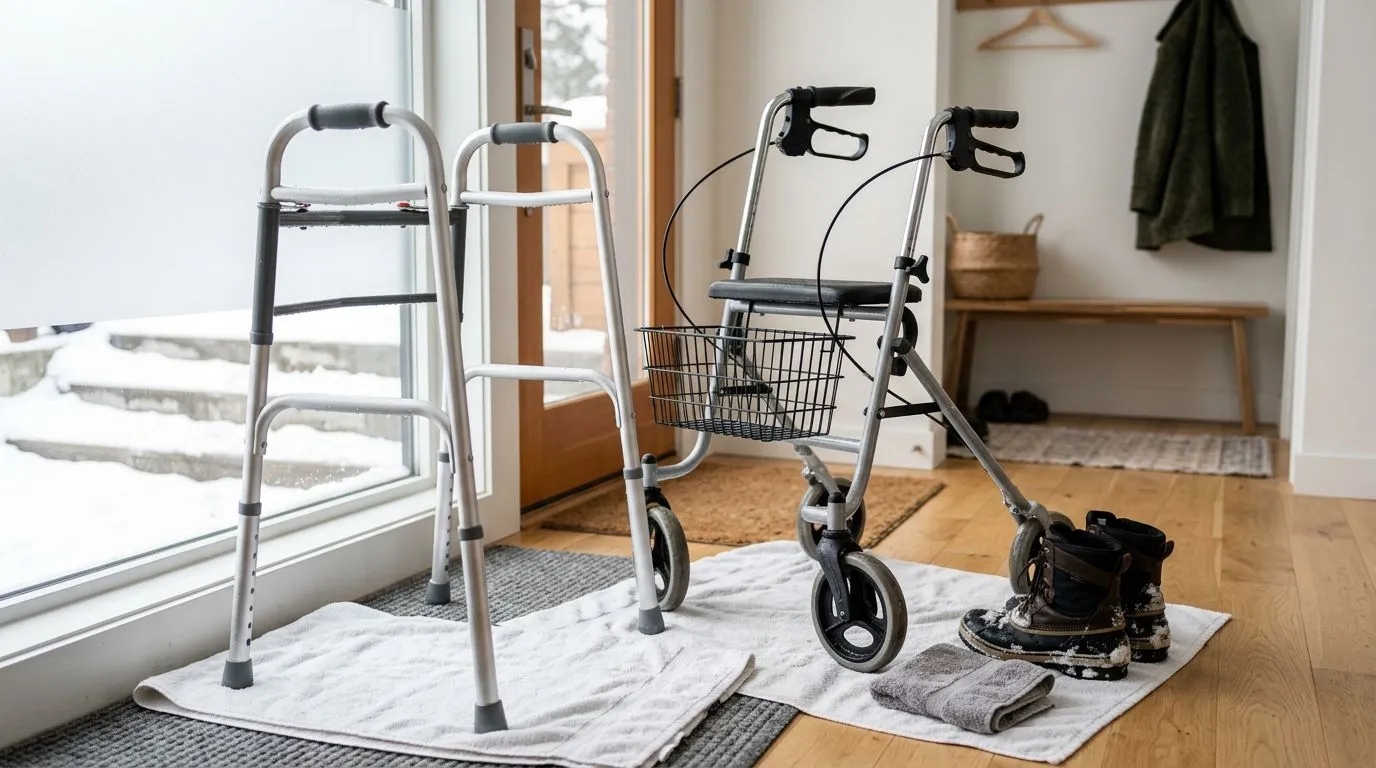
How to Keep a Walker or Rollator From Rusting: Rain, Snow, Salt, Storage, and Drying Tips
13 min read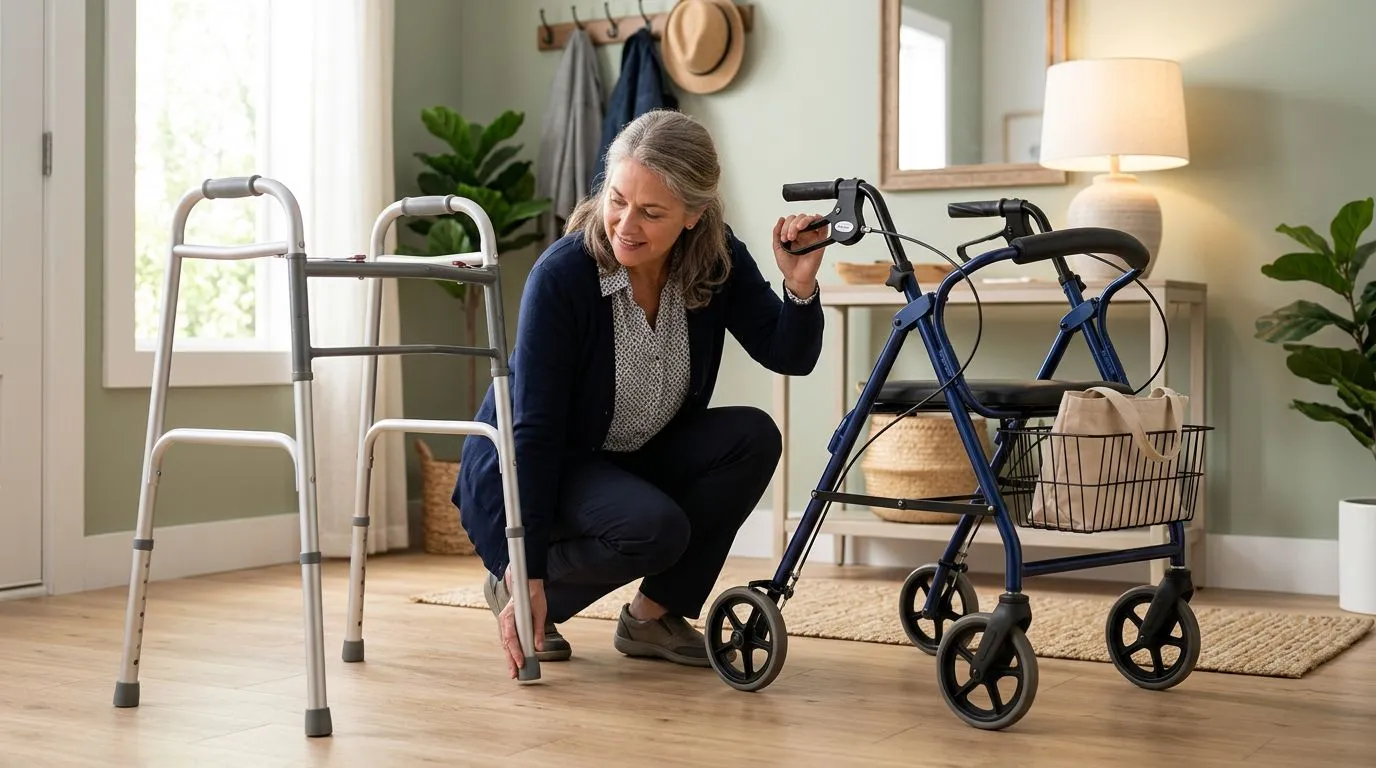
Walker and Rollator Maintenance Checklist: Weekly, Monthly, and Before Trips
13 min read