Disclosure: We may earn a commission when you buy through links on this page, at no extra cost to you. We buy nothing, sell nothing and accept no payment for coverage — commissions never decide what we recommend. How we make money.
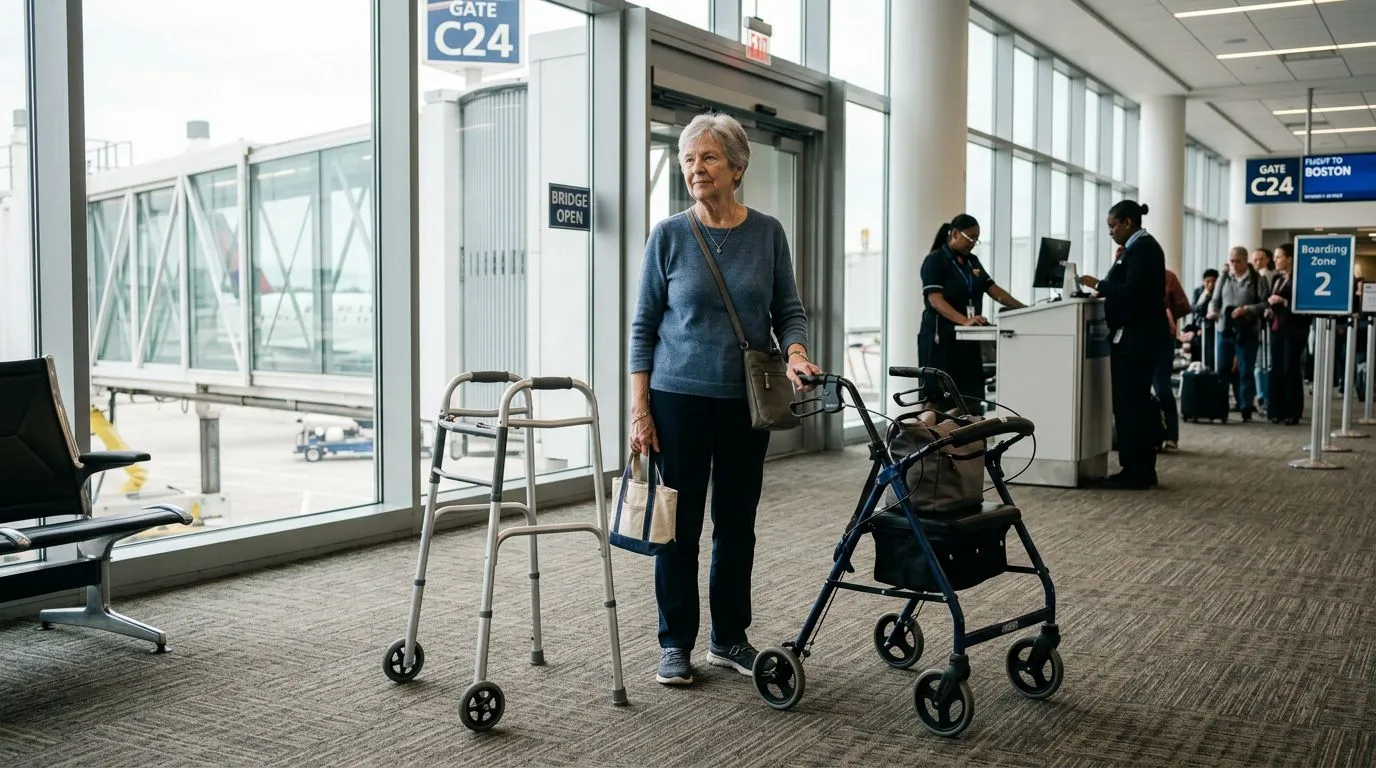
Yes, you can take a walker or rollator on a plane in the United States. Standard walkers, folding walkers, two-wheel walkers, and rollators are treated as mobility aids, so airlines must let passengers travel with them without counting them as regular carry-on baggage.
How they are handled depends on size, foldability, and available cabin storage. A compact folding walker may fit in an onboard closet or overhead bin, while most 3-wheel and 4-wheel rollators are gate checked and returned at the aircraft door or baggage claim.
Walkers and rollators are allowed on U.S. flights
Under U.S. air travel rules, mobility aids such as walkers and rollators are considered assistive devices. That matters because an assistive device is not treated like an ordinary suitcase. If you use a walker or rollator for mobility, you can bring it through the airport, through TSA screening, and to the gate.
Airlines generally ask for at least 48 hours of advance notice if you need certain disability-related assistance, such as wheelchair help through a large airport. You do not need special permission simply to travel with a standard walker or rollator. Even so, calling ahead is wise if your device is large, bariatric, unusually tall, or difficult to fold.
The usual airport process is straightforward: use your walker or rollator until you board, have it inspected by TSA, then either stow it in the cabin if size and space allow or gate check it at the jet bridge. When you arrive, ask for it to be brought back to the aircraft door whenever possible, especially if you cannot walk safely without it.
There is one key distinction: a walker and a rollator are not the same. A walker is usually a frame with no seat and either no wheels or 2 front wheels. A rollator is a wheeled walker, usually with 3 or 4 wheels, hand brakes, and often a built-in seat. That difference affects screening, folding, storage, and damage risk.
Walker vs. rollator on a plane: what changes in real airport handling
A standard walker is often easier to manage during air travel because it has fewer moving parts. Many folding walkers collapse to only a few inches thick, and some weigh about 6 to 8 lb. Two-wheel walkers add front wheels but still fold flatter than most rollators.
Rollators are bulkier. A 4-wheel rollator commonly weighs about 15 to 25 lb, and bariatric rollators can weigh more. They may have brake cables, a padded seat, a storage pouch, adjustable handles, and larger wheels. Those features are useful in daily life, but they also create more points where airline handling can cause bending, scraping, or misalignment.
| Mobility aid type | Typical airport handling | What to watch for |
|---|---|---|
| Standard no-wheel walker | Often folds flat and may fit in cabin storage | Rubber tips can loosen or scuff |
| Two-wheel folding walker | May be cabin-stowed or gate checked | Front wheels and glide caps can catch during handling |
| 3-wheel rollator | Usually gate checked because of frame shape | Brake cables and front wheel alignment |
| 4-wheel rollator with seat | Usually gate checked at the jet bridge | Seat, basket, brakes, and folding latch |
| Upright or stand-up rollator | Often gate checked due height and arm supports | Forearm pads, tall handles, and brake cables |
| Bariatric rollator | Gate checked; may need extra handling time | Wider frame, heavier weight, and wheel clearance |
If you can safely walk short distances without your device, the airline may ask to take it at the aircraft door. If you cannot, say so clearly. You can request an aisle chair for boarding if the cabin aisle is too narrow for safe walking. Many aircraft aisles are around 15 to 20 inches wide, which is too narrow for most walkers and nearly all rollators.
Before your trip: call the airline at least 48 hours ahead when possible
You do not need to make the pre-trip call complicated. The goal is to ensure your reservation notes say you are traveling with a mobility aid and need it returned promptly when you land. A 5-minute call can prevent confusion at the check-in counter and gate.
Have a few details ready: the device type, whether it folds, approximate weight, and any removable parts. For example, say, I am traveling with a folding two-wheel walker that I need until the aircraft door, or I use a 4-wheel rollator with hand brakes and a seat, and I need it returned at the gate after landing.
If your trip includes a connection under 60 minutes, be especially direct. Tell the airline you need your walker or rollator during the connection, not only at final baggage claim. Short connections create the highest risk of the device being sent to baggage claim or delayed at the jet bridge.
- Ask whether the device can be tagged for return at the aircraft door.
- Request wheelchair assistance if long airport distances are difficult.
- Ask how the airline handles mobility aids on smaller regional aircraft.
- Confirm any connection assistance, especially for terminals that require a train or shuttle.
- Write down the date of the call and any assistance notes added to the reservation.
For international flights, rules can vary outside the U.S. If you depart from or return to a U.S. airport, U.S. disability access rules still matter, but foreign airport handling may differ. For trips abroad, give more notice and check each airline on the itinerary.
TSA screening: what happens at the checkpoint in 3 basic steps
At TSA, your walker or rollator must be screened, but you do not have to give up safe mobility to do it. If you can walk through the scanner or metal detector without support, an officer may send the walker or rollator through the X-ray machine if it fits. If it does not fit, TSA can inspect it by hand.
If you cannot stand or walk without the device, tell the officer before screening begins. TSA can provide alternate screening, which may include a pat-down, explosive trace swabs, and visual inspection of the walker or rollator. This can add 5 to 15 minutes, depending on the airport and line.
- Tell the officer what you need: I cannot walk safely without this walker, or I need my rollator for balance.
- Remove loose items from pouches, baskets, trays, or under-seat bags before the device is inspected.
- Wait until TSA returns the device and confirms it is clear before moving forward.
Rollators with under-seat bags should be emptied enough that officers can see inside. A water bottle, medication pouch, phone, or travel documents can stay with you in a small personal bag instead of being left attached to the rollator. This reduces the chance that important items go through screening separately or get overlooked.
Do not rush. Falls at checkpoints often happen when travelers try to manage shoes, bins, coats, and mobility aids all at once. If removing shoes is difficult, ask whether alternate screening is available. TSA officers screen thousands of mobility devices every day, and clear communication is usually the fastest route.
Cabin storage vs. gate check: the 2 main options
After TSA, the next question is whether the walker or rollator can be stored in the cabin or needs to be gate checked. Cabin storage is most realistic for folding walkers. A flat-folding standard walker may fit in an onboard closet or overhead bin, depending on aircraft type and available space.
Rollators are different. Because a rollator has 3 or 4 wheels, hand brakes, a seat, and a deeper folded profile, it usually will not fit safely in the overhead bin. Most rollators are tagged at the gate and taken at the aircraft door. This is normal and should not require a fee.
| Option | Best for | Pros | Limits |
|---|---|---|---|
| Cabin closet or overhead storage | Compact folding walkers | Lowest handling risk and fastest arrival access | Space is limited and not guaranteed |
| Gate check at jet bridge | Most rollators and larger walkers | You use it until boarding | Device may be returned at aircraft door or baggage claim depending on handling |
| Checked at ticket counter | Backup or spare device only | Less to manage through airport | Not ideal if you need it for walking before boarding |
At the gate, ask for a claim tag before boarding starts. Make sure the tag identifies the device as a mobility aid, and confirm where it should be returned. If the gate agent says it will go to baggage claim, explain if you need it at the aircraft door. Be polite but specific: I need this rollator returned at the gate because I cannot walk the jet bridge safely without it.
On small regional jets, even compact walkers may need to be gate checked because cabin storage is limited. On larger aircraft, a folding walker has a better chance of staying onboard, although closets may already be reserved for other assistive devices or crew items.
How to measure your walker or rollator before flying
Measure your device at home in its folded position. You do not need perfect technical drawings, but you should know 3 numbers: folded height, folded width, and folded depth. Write them on a luggage tag or note in your phone. A typical folded walker may be roughly 4 to 6 inches deep, while a folded rollator may be 10 to 15 inches deep or more.
Check the weight as well. A lightweight walker around 7 lb is easier for staff to lift carefully than a heavy rollator over 20 lb. Bariatric rollators may have weight capacities of 300, 400, or 500 lb, but the device itself can also be heavier and wider than a standard frame.
- Folded height: Measure from the floor to the tallest handle or frame point after folding.
- Folded width: Measure across the widest wheel, handle, or frame section.
- Folded depth: Measure the thickness of the folded device from front to back.
- Device weight: Use a home scale if you can safely lift it, or check paperwork if available.
- Removable parts: Note baskets, cane holders, cup holders, trays, and backrests.
Handle height matters too. Many walkers and rollators adjust in 1-inch increments. Before travel, mark your normal handle setting with a small piece of tape or a permanent marker line. If the handles are lowered for transport, you can reset them quickly after landing.
If you are deciding between traveling with a standard walker and a rollator, consider the airport distance. Some large U.S. airports require walking a quarter mile or more between curb, security, and gate. A rollator seat can help during long waits, but a folding walker is simpler to lift, screen, and stow.
Damage prevention: protect 5 vulnerable parts before gate check
Gate checking is common, but mobility aids are not indestructible. The most vulnerable parts are brake cables, wheels, folding latches, seats, and removable accessories. A few minutes of preparation can significantly lower the risk of damage.
Start by removing anything that is not built into the frame. Baskets, cup holders, clip-on lights, trays, and loose under-seat bags should travel in your carry-on if possible. If an accessory sticks out even 2 inches from the frame, it is more likely to snag on a belt, cart, or aircraft hold.
- Brake cables: Use soft hook-and-loop straps or twist ties to keep cables close to the frame without pinching them.
- Wheels: Check that axle bolts or quick-release parts are secure before leaving home.
- Seat and backrest: Fold or lower them fully if the design allows.
- Folding latch: Make sure the frame is locked in its folded position before handing it over.
- Rubber tips and glides: Press them firmly onto walker legs so they do not fall off in transit.
Take 4 photos at the gate: front, back, side, and close-up of brakes or wheels. Photos do not prevent damage, but they help document condition if you need to file a report. Include the gate tag in at least 1 photo after it is attached.
Do not wrap the entire walker or rollator in a way that prevents staff from lifting it safely. A clear plastic bag can help contain a small folding walker, but many rollators are too large for practical bagging. Padding brake handles with a towel or soft wrap is more useful than heavy tape across the frame.
Who is best served by a walker vs. a rollator for air travel
The best travel device is the one you can use safely, not the one that is easiest for the airline. Still, different designs suit different airport needs. A standard walker gives stable support and folds flat; a rollator offers smoother movement and a seat but is bulkier and more damage-prone.
| Traveler need | Often better choice | Why |
|---|---|---|
| Maximum stability for short distances | Standard or folding walker | No-wheel frames do not roll away and can feel more controlled |
| Long airport walks with rest breaks | 4-wheel rollator with seat | The seat can help during delays or long gate waits |
| Narrow spaces and easier lifting | Folding walker | Many fold flatter than 6 inches deep |
| Outdoor curb-to-gate travel | Rollator with larger wheels | Larger wheels handle uneven sidewalks better than small tips |
| Standing more upright while walking | Upright rollator | Higher forearm supports may reduce stooping for some users |
| Higher weight capacity needs | Bariatric walker or bariatric rollator | Wider, reinforced frames may support 300 lb or more depending on design |
If you normally use a rollator, do not switch to a walker for a trip unless you have practiced with it and your clinician agrees it is appropriate. The same is true in the other direction. A rollator requires hand brake use and control on slopes; it is not automatically safer just because it has a seat.
For travelers who own both, a folding walker can be practical for short trips with lots of taxis, shuttles, and tight hotel rooms. A rollator can work better for cruises, large resorts, and airports with long concourses. Think in real distances: a 20-minute security line and a 10-minute walk to the gate may be manageable with one device and exhausting with another.
At boarding and arrival: what to say in the final 10 minutes
The last 10 minutes before boarding are when many mix-ups happen. Gate agents are managing seats, bags, wheelchairs, strollers, and on-time departure. Make your needs clear early, ideally before the boarding line forms.
Ask the gate agent to tag your walker or rollator and confirm the return point. If you need preboarding, request it. Preboarding gives you extra time to move carefully, fold the device, transfer to an aisle chair if needed, and avoid pressure from a line of passengers behind you.
- Say: I need this walker until the aircraft door.
- Say: Please tag this rollator to be returned at the arrival gate.
- Say: I need an aisle chair if the plane aisle is too narrow for safe walking.
- Ask: Will this come back to the jet bridge or baggage claim?
- Confirm: The brakes are locked and the frame is folded.
When you arrive, stay seated until assistance is ready if you cannot walk safely without your device. It may take several minutes for gate-checked mobility aids to be brought up from the aircraft hold. If the walker or rollator is not there, notify the airline before leaving the gate area.
Inspect the device before going far. Check that the frame opens and locks, wheels turn smoothly, brakes stop the wheels, rubber tips are still attached, and the seat or backrest is secure. A rollator with weak brakes or a walker that does not lock open should not be used as if nothing happened.
If your walker or rollator is damaged or delayed
If damage happens, report it immediately to the airline, ideally before leaving the airport. U.S. airlines have responsibilities when mobility aids are damaged during transport, and a same-day report is much stronger than a call made 2 days later from home.
Use plain language and be specific. For example: The right brake cable on my rollator is bent and the brake no longer holds, or the folding latch on my walker will not lock. Show your gate photos if you took them. Ask for a written damage report or claim number before you leave.
If the device is unsafe to use, tell the airline you need assistance and a suitable temporary solution. Do not try to walk through a terminal with a rollator that will not brake or a walker with a bent leg. Even a 30-foot walk to baggage claim can be risky when support equipment is compromised.
Keep receipts for repairs, replacement parts, taxis, or rental equipment if those costs become necessary because of airline handling. Policies and procedures can vary, but documentation gives you the best chance of a fair resolution.
Bottom line for flying with walkers and rollators
Walkers and rollators can travel on planes, and you can use them through most of the airport until boarding. The main differences are practical: folding walkers are easier to stow, while rollators are usually gate checked because they are larger and have brakes, wheels, and seats.
Before flying, measure the device, remove loose accessories, protect brake cables, and call the airline if you need assistance or have a tight connection. At TSA and the gate, clear communication matters more than perfect terminology. Say what you use, what you need, and whether you can walk safely without it.
A little preparation can make the trip smoother. It also helps ensure your walker or rollator is waiting for you in usable condition when the aircraft door opens.
FAQ
Frequently asked questions
Does a walker or rollator count as a carry-on bag? +
No. In U.S. air travel, walkers and rollators used for mobility are generally treated as assistive devices, not regular carry-on luggage. They should not count against your carry-on or personal item allowance.
Can I keep my walker with me on the plane? +
Sometimes. A compact folding walker may fit in an onboard closet or overhead bin if space is available. Most rollators are too bulky for cabin storage and are usually gate checked at the aircraft door.
Will TSA take my walker or rollator away during screening? +
TSA must screen the device, but you can tell officers if you cannot stand or walk safely without it. If it fits, it may go through X-ray; if not, TSA can inspect it by hand and may use swabs or alternate screening.
Should I gate check or counter check a rollator? +
If you need the rollator to move through the airport, gate check is usually better. You can use it until boarding and request that it be returned at the arrival gate or jet bridge.
What should I remove from my rollator before flying? +
Remove loose accessories such as baskets, cup holders, trays, cane holders, and under-seat bags when possible. Keep medications, documents, phone, and valuables in a separate carry-on bag.
What if my walker or rollator is damaged by the airline? +
Report the damage before leaving the airport if possible. Ask for a written claim number, show photos if you have them, and do not use the device if the frame, brakes, wheels, or locking mechanism are unsafe.
Keep reading
Related guides

Cruise Travel With a Walker or Rollator: Cabin Fit, Boarding, Excursions, and Port-Day Safety
13 min read
Road Trips With a Walker or Rollator: Loading the Car, Planning Stops, and Staying Safe
15 min read
Traveling With a Rollator Walker: Car Trunks, Folding Size, and Airplane Rules
13 min read