Disclosure: We may earn a commission when you buy through links on this page, at no extra cost to you. We buy nothing, sell nothing and accept no payment for coverage — commissions never decide what we recommend. How we make money.

If your rollator has become harder to push, pulls to one side, or rolls with a bumpy wobble, dirty wheels or clogged axles are often to blame. Hair, lint, grit, and outdoor debris can wrap around the wheel hub in as little as 1 trip across a parking lot or bathroom floor. A careful 15- to 30-minute cleaning can often bring back smoother rolling without replacing the walker.
This guide focuses on rollators, including 3-wheel, 4-wheel, upright, and bariatric rollators. It also explains what changes for two-wheel walkers and standard no-wheel walker frames, since many people use the word “walker” for several different mobility aids.
Why dirty rollator wheels can change how a walker feels in 1 week
A rollator is a wheeled walker with hand brakes, and most 4-wheel rollators also have a built-in seat. Because every wheel stays on the floor, the device depends on clean wheel movement and even brake contact. When one wheel has more resistance than the others, the rollator may feel as if it is dragging, turning, or fighting you.
Hair is the most common indoor culprit. Long hair, pet fur, carpet fibers, thread, and lint can wind around the axle area next to the wheel. Outside, tiny stones, mud, leaf bits, and road grit can lodge near the caster fork or tread. Even a 1/16-inch layer of packed debris may be enough to make a small front wheel swivel poorly.
Rollator wheels are usually about 6 to 10 inches in diameter. Smaller wheels can be more sensitive to debris because they have less clearance over thresholds and rough surfaces. Larger wheels may roll more easily outdoors, but they still collect hair around the hub.
Standard walkers without wheels do not have this issue, though their rubber tips can wear down. Two-wheel walkers can collect debris at the front wheels, while the rear legs rely on tips or glide caps. That difference matters when you diagnose the problem.
Signs the problem is wheel debris, not your walking technique
Not every hard-to-push walker needs repair. Start by noticing when the problem appears. If the rollator rolled smoothly last month and now takes noticeably more effort on the same hallway or kitchen floor, the wheels and axles deserve a closer look.
- Pulling to one side: One wheel may be clogged, worn, loose, or braking slightly.
- Clicking or scraping: A twig, pebble, or hardened dirt may be rubbing near the fork.
- Uneven rolling: Hair wrapped around 1 front wheel can make the rollator feel lopsided.
- Hard steering: Front caster wheels may not swivel freely through a full 360 degrees.
- Brake rubbing: A brake pad or cable may be touching the wheel when the hand brake is released.
Try a simple test on a flat indoor surface that is at least 6 feet long. With no one leaning on it, push the rollator forward gently and watch whether it tracks straight. Then lift the rollator slightly, spin each wheel by hand, and compare how long each one turns. If one wheel stops after 1 second while the others spin for several seconds, that wheel probably needs attention.
Do not test by pushing the rollator down a ramp or letting it roll away. Keep one hand on the frame, and engage the parking brakes whenever you stop working.
Tools and setup for a 20-minute rollator wheel cleaning
You do not need a workshop for routine maintenance. A kitchen towel, good lighting, and a few household items are usually enough. Plan on 20 minutes for a basic cleaning, or closer to 45 minutes if there is heavy hair buildup around all 4 wheels.
| Item | Use | Safety note |
|---|---|---|
| Old towel or mat | Protects the floor and catches debris | Choose a non-slip surface |
| Disposable gloves | Keeps hands clean | Helpful when removing hair or mud |
| Small scissors or seam ripper | Cuts hair wrapped around the axle | Keep blades away from brake cables |
| Tweezers or needle-nose pliers | Pulls out fibers and small stones | Do not force parts out of alignment |
| Soft brush or old toothbrush | Loosens dirt from treads and forks | Avoid wire brushes on plastic wheels |
| Mild dish soap and damp cloth | Cleans wheel surfaces | Do not soak bearings or brake parts |
| Flashlight | Shows debris near hubs | Check both sides of each wheel |
Work with the rollator folded or standing, whichever gives you safe access. If it has a seat, remove loose items from the storage pouch first. A basket or bag with 5 pounds of belongings can make the frame tip unexpectedly when you lift one end.
If bending is uncomfortable, place the rollator beside a sturdy chair and clean one wheel at a time while seated. Ask for help if you cannot see the axle clearly. Never put your fingers near a wheel while another person is pushing the rollator.
How to remove hair from rollator axles in 6 careful steps
Hair usually wraps tightest where the wheel meets the fork or frame. The goal is to cut and pull it free without nicking the tire, loosening a brake cable, or bending the fork.
- Engage the parking brakes. Lock both hand brakes before you start. If the rollator has loop brakes, push them down until they click into the parked position.
- Inspect both sides of the wheel. Use a flashlight. Hair may be hidden behind the wheel, especially on a rear wheel near the brake arm.
- Cut the wrap in short sections. Use small scissors, a seam ripper, or a craft knife only if you have steady control. Make 2 or 3 small cuts instead of pulling hard on one long strand.
- Pull fibers outward. Tweezers or needle-nose pliers help remove hair from the axle gap. Pull away from the hub, not into it.
- Spin and repeat. Rotate the wheel 90 degrees at a time and keep checking until the axle area looks clear.
- Wipe the hub. Use a slightly damp cloth to remove fine dust. Dry the area before testing the wheel.
For severe buildup, some rollators allow wheel removal with a nut, bolt, push-button axle, or quick-release style part. Only remove a wheel if the user manual explains how and you can reinstall it securely. A wheel that is not fully tightened can create a fall risk. If the wheel wobbles more than about 1/8 inch side to side after reassembly, stop using the rollator until it is checked.
How to clean dirt, grit, and sticky residue from 6- to 10-inch wheels
Rollator wheels move through kitchens, sidewalks, medical offices, garden paths, and parking lots. Sticky residue from floors, mud from rain, and grit from pavement can build up on the tread. That buildup affects traction and can make braking less predictable.
First, brush the tread while turning the wheel by hand. An old toothbrush works well for grooves. If the wheel has a flat center band and shallow side grooves, clean both edges because grit often hides at the seam. For compacted mud, hold a damp cloth against the tread and rotate the wheel slowly.
Use mild dish soap diluted in water for sticky spots. A pea-sized drop of soap on a damp cloth is plenty for one wheel. Avoid soaking the wheel, spraying water into the hub, or using harsh solvents. Strong cleaners can damage rubber-like tires, plastic rims, painted frames, or brake surfaces.
After cleaning, dry each wheel with a towel. Test the brakes on a flat surface. Roll the walker forward 2 to 3 feet and squeeze the hand brakes. The rollator should stop evenly, without one side grabbing much sooner than the other. If the brake lever feels loose or the wheel keeps rolling with the brake fully squeezed, cleaning alone is not enough.
Outdoor users should clean more often. A rollator used daily on sidewalks may need a quick wheel wipe every 1 to 2 weeks, while one used mainly indoors may only need a monthly check.
What changes for 3-wheel, 4-wheel, upright, and bariatric rollators
The cleaning steps are similar across rollator types, but the parts you inspect can vary. A 3-wheel rollator has a different frame shape than a 4-wheel rollator, and an upright rollator may have taller supports that change how the front wheels carry weight.
| Type | Typical wheel setup | Maintenance focus | Best for |
|---|---|---|---|
| 3-wheel rollator | 1 front wheel, 2 rear wheels | Front swivel wheel and rear brake contact | People who want tighter turning in narrow spaces |
| 4-wheel rollator | 2 front wheels, 2 rear wheels | Front caster swivel and both rear brake areas | People who want a seat and more stable support when stopping |
| Upright rollator | Usually 4 wheels, taller frame | Front wheel alignment and brake cable routing | People who use forearm supports or a more upright posture, if appropriate |
| Bariatric rollator | Often wider frame, heavy-duty wheels | Axle tightness, tread wear, and frame clearances | People who need a higher stated weight capacity, often 300 pounds or more |
On a 3-wheel rollator, pay close attention to the single front wheel. If that wheel is clogged, the entire walker may steer poorly. On a 4-wheel rollator, compare the 2 front wheels; if one caster swivels freely and the other does not, hair or grit may be lodged at the fork.
Upright rollators often have more frame tubing and longer brake cable paths. Make sure a cable has not shifted into a wheel area after folding or loading the device into a car. Bariatric rollators may have wider wheels and stronger hardware, but they still need the same visual checks. Higher capacity does not mean debris cannot affect rolling.
Walker versus rollator maintenance: the 2-wheel difference
Many people say “walker” when they mean any mobility aid with a frame. For maintenance, the difference matters. A standard walker has 4 legs and no wheels; a two-wheel walker has wheels on the front and tips or glides on the back; a rollator has 3 or 4 wheels plus hand brakes, and most 4-wheel models include a seat.
| Device type | Wheels | Brake system | Main maintenance concern |
|---|---|---|---|
| Standard walker | 0 | No hand brakes | Rubber tips, frame locks, loose hand grips |
| Two-wheel walker | 2 front wheels | No rollator-style hand brakes | Front wheel debris and rear tip wear |
| 3-wheel rollator | 3 | Hand brakes | Wheel hubs, caster swivel, brake adjustment |
| 4-wheel rollator | 4 | Hand brakes | All wheels, seat hardware, brake contact |
If you use a two-wheel walker, clean the front wheel axles the same way you would clean rollator wheels. Then inspect the rear rubber tips. A rear tip worn through on one side can make the walker drag or pull even when the front wheels are clean. Replace worn tips with the correct size; common walker leg tips are measured by the outside diameter of the tubing, often around 1 inch, but you should measure your own frame.
For a standard no-wheel walker, wheel cleaning is not relevant. Instead, check that all 4 tips contact the floor evenly and that folding buttons fully lock. A walker that rocks on a flat floor may have uneven tips, bent tubing, or a loose adjustment point.
How to measure wheels, clearance, and brake contact before replacing parts
Cleaning solves many rolling problems, but not all of them. If a wheel is cracked, flattened, loose, or deeply worn, replacement may be needed. Measure before buying generic replacement parts, because rollator wheels are not universal.
Use a tape measure and write down 3 numbers. First, measure the wheel diameter from top to bottom; common sizes include 6, 7, 8, and 10 inches. Second, measure wheel width across the tread. Third, note the axle style and approximate bolt diameter if visible. If you cannot safely remove the wheel, do not guess based on appearance alone.
Check clearance as well. There should be visible space between the wheel and fork so the wheel can spin without rubbing. A small amount of side play can be normal, but wobbling, scraping, or a wheel that sits crooked needs attention. On rear wheels, look at where the brake pad or brake shoe contacts the tire. When the hand brake is released, the brake should not rub continuously.
Handle height can also affect how a rollator tracks. Many handles adjust in 1-inch increments. A common starting point is to stand inside the rollator with shoulders relaxed and set the hand grips near wrist crease height. If one handle is set 1 hole higher than the other, the user may push unevenly and think the wheels are at fault. For upright rollators with forearm rests, follow the fit guidance for that style and consider help from a clinician if posture or balance is a concern.
Who DIY wheel cleaning is best for, and when to get help within 24 hours
Routine wheel cleaning is best for users or caregivers who can safely see the axle, keep the rollator stable, and use small tools without forcing parts. It is a good first step when the problem appeared gradually, the frame is not bent, and the brakes still stop the walker evenly.
Get help promptly if the rollator suddenly pulls hard to one side, a wheel is cracked, a brake cable is frayed, or a wheel will not stay attached. Do not keep using a rollator with a loose axle, missing fastener, or brake that fails to hold on a gentle slope. Even a short 10-foot walk from bed to bathroom can be riskier when the device does not roll or stop predictably.
A mobility equipment provider, repair technician, or qualified clinician can check brake tension, wheel alignment, frame damage, and fit. If the rollator was supplied through insurance or a medical provider, ask about service options before modifying parts. Avoid drilling, bending forks, adding oil to brake surfaces, or substituting hardware that does not match the original size and strength.
For many households, a simple maintenance routine prevents bigger problems: quick visual check weekly, hair removal monthly, brake test after cleaning, and a deeper inspection every 3 months. Add an extra check after rain, a beach trip, a muddy parking lot, or travel in a car trunk where brake cables can be bumped.
FAQ
Frequently asked questions
How often should I clean rollator wheels? +
Check the wheels weekly and do a quick wipe whenever you see hair, grit, or mud. For daily outdoor use, a more careful cleaning every 1 to 2 weeks is reasonable; mostly indoor rollators may only need it monthly.
Can I use oil or lubricant on squeaky rollator wheels? +
Use caution. Do not put oil on tires, brake pads, or any surface the brakes touch. If the manual allows lubrication at a bearing or pivot point, use only a small amount of the recommended type and wipe away excess.
Why does my rollator pull to one side after I cleaned the wheels? +
The cause may be brake rubbing, uneven handle height, a worn wheel, a loose axle, or a bent fork or frame. Compare wheel spin on both sides and check that both brakes release fully. If it still pulls, have it inspected.
Is it safe to remove a rollator wheel for cleaning? +
Only remove a wheel if your user manual explains the process and you can reinstall it securely. If you are unsure about the axle, fastener, or brake position, clean around the wheel without removing it or ask a repair professional.
Do standard walkers need wheel maintenance? +
A standard walker has no wheels, so it does not need wheel cleaning. It does need regular checks for worn rubber tips, loose hand grips, and fully locked folding mechanisms. Two-wheel walkers need both front wheel cleaning and rear tip inspection.
Keep reading
Related guides

Can a Mobility Walker or Rollator Be Repaired? DIY Fixes, Replacement Parts, and When to Get Service
14 min read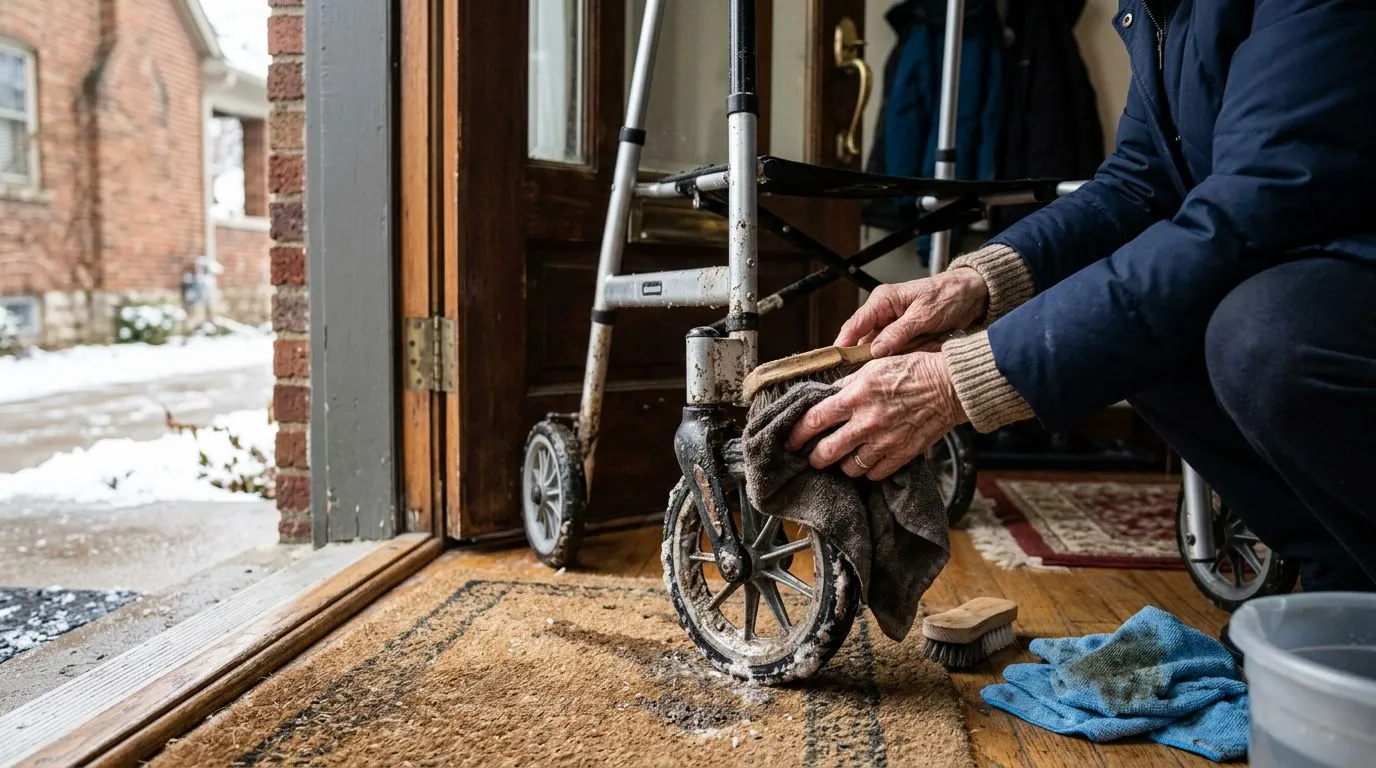
Outdoor Walker Care: Cleaning Mud, Rain, Road Salt, and Rust Before They Cause Damage
14 min read
How to Stop a Walker or Rollator From Squeaking, Rattling, or Feeling Loose
12 min read