Disclosure: We may earn a commission when you buy through links on this page, at no extra cost to you. We buy nothing, sell nothing and accept no payment for coverage — commissions never decide what we recommend. How we make money.

If you need a walker or rollator right away, buying one before insurance approval can solve an urgent mobility problem, but it can also make reimbursement harder or impossible. The biggest risks are buying from the wrong supplier, purchasing before the required medical order or authorization, choosing a device insurance does not consider medically necessary, or missing the paperwork needed for a claim. A better plan is to call your insurer and prescribing clinician first, ask a local durable medical equipment supplier about same-day options, and use a short-term rental, loaner, or carefully checked secondhand device if you need help while approval is pending.
The 4 reimbursement risks to know before you pay
Paying cash first feels simple. You walk into a local store, order online, or pick up a used walker the same day. The problem is that insurance reimbursement often depends on rules that must be followed before the purchase date.
For Medicare Part B, walkers are generally treated as durable medical equipment when they are medically necessary for use in the home. Many private plans and Medicaid programs use similar concepts, but the exact process varies. A claim may require a clinician's order, a diagnosis or mobility limitation, a participating DME supplier, and a detailed receipt showing the item provided.
These are the most common pay-first problems:
- The purchase happened before the order. If the prescription or documentation is dated after the receipt, the plan may say the item was not properly ordered at the time of purchase.
- The seller was not eligible. Some insurance plans reimburse only when the walker or rollator comes from an enrolled, in-network, or approved durable medical equipment supplier.
- The device does not match the covered need. A standard walker, two-wheel walker, 4-wheel rollator, bariatric rollator, or upright rollator may be treated differently depending on the plan and documentation.
- The paperwork is incomplete. A generic store receipt may not include the purchaser's name, date of service, product type, diagnosis-related information, itemized cost, or supplier details needed for a claim.
That does not mean you should wait unsafely for days or weeks if you cannot move around your home. It means the first phone calls matter. Ten minutes with the insurer and clinician can prevent a costly mistake.
Walkers vs. rollators: 2 different tools insurance may review differently
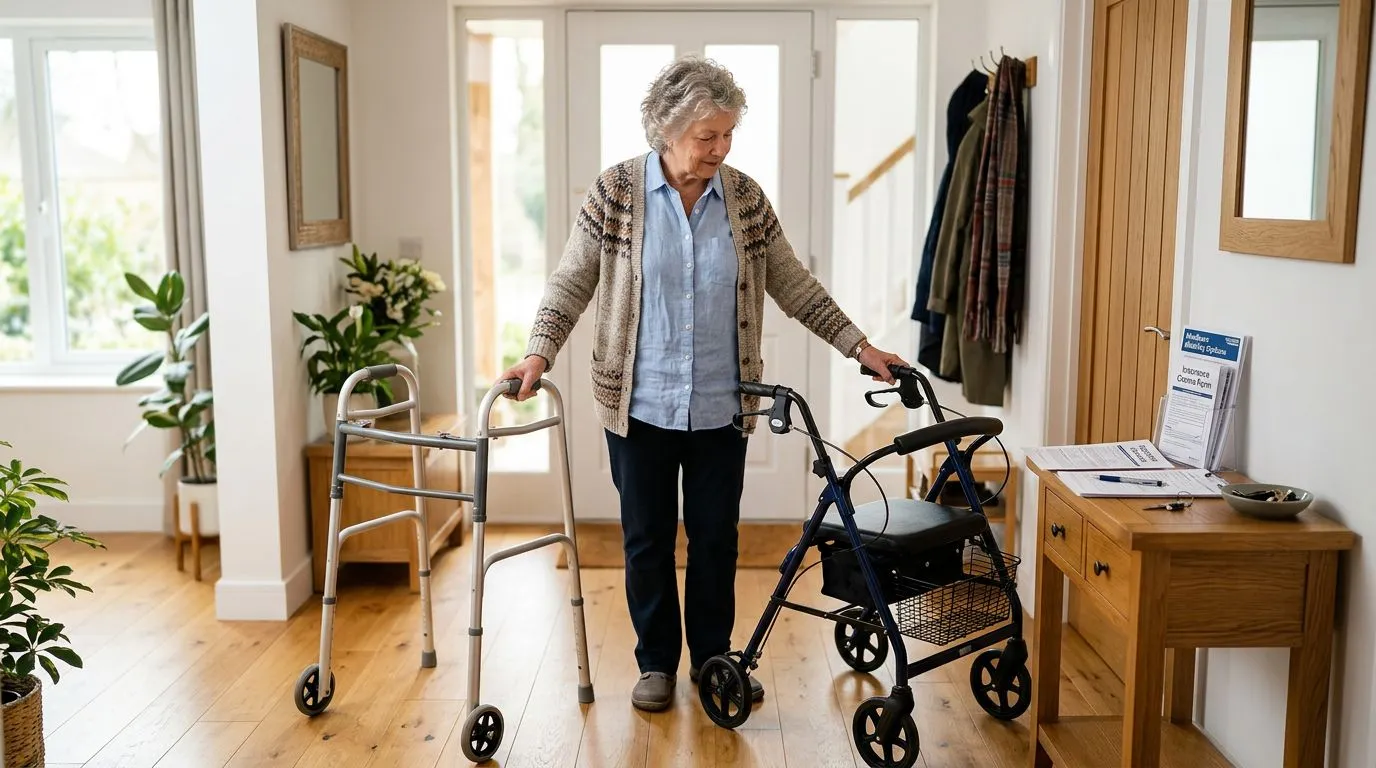
A walker and a rollator are related mobility aids, but they are not the same device. A standard walker is a frame you lift and place, usually with no wheels or with 2 front wheels. A rollator is a wheeled walker, usually with 3 or 4 wheels, hand brakes, and often a built-in seat.
This difference matters because insurance looks at medical necessity, not just convenience. A standard or two-wheel walker may be appropriate for someone who needs maximum stability and can bear weight through the arms. A rollator may fit someone who can safely manage hand brakes and benefits from continuous rolling movement, but the seat, storage pouch, or upright posture features may not always be treated as essential by every plan.
| Type | Typical features | Who it is often best for | Reimbursement caution |
|---|---|---|---|
| Standard walker | No wheels, aluminum frame, often folds; commonly 5 to 8 lb | People needing high stability for short indoor distances | Usually easier to justify when balance support is the main need |
| Two-wheel walker | 2 front wheels, rear tips or glides, foldable frame | People who have trouble lifting a no-wheel walker each step | Documentation should explain why wheels are needed |
| 3-wheel rollator | 3 wheels, hand brakes, narrow turning radius, usually no full seat | People needing maneuverability in tight spaces | May be reviewed differently than a standard walker |
| 4-wheel rollator | 4 wheels, hand brakes, seat, backrest, storage pouch | People who walk farther but need rest breaks | Seat and comfort features may not be covered if seen as convenience |
| Upright rollator | Forearm supports, hand brakes, 4 wheels, taller frame | People who need a more upright posture and can control the device safely | Often requires careful documentation because it may cost more than basic options |
| Bariatric walker or rollator | Wider frame, reinforced construction, often 350 to 500+ lb capacity | People above standard weight limits or needing a wider stance | Weight capacity and body measurements should be documented |
If you are not sure whether you need a walker or a rollator, ask the clinician to write the order for the medically appropriate category rather than a vague phrase such as “mobility aid.” A clear order can reduce confusion later.
Before you buy today: make 3 calls in this order
When the need is urgent, you do not have to spend all day researching. Make 3 focused calls before spending your own money.
1. Call the prescribing clinician
Ask whether they can provide a written order for the specific type of device: standard walker, folding walker, two-wheel walker, 3-wheel rollator, 4-wheel rollator, upright rollator, or bariatric rollator. If you recently had surgery, a fall, a hospital stay, or a change in walking ability, ask whether physical therapy or occupational therapy can recommend the safest style and height.
2. Call your insurance plan
Use the member number on your card and ask about durable medical equipment benefits. Write down the date, time, representative name, and any reference number. Ask whether prior authorization is required, whether you must use an in-network DME supplier, what documentation is needed, and whether reimbursement is allowed if you buy the item yourself.
3. Call a local DME supplier
A medical equipment supplier may know which walkers and rollators are commonly covered by your plan and whether same-day pickup is possible. Some suppliers can coordinate paperwork with your clinician. Ask if they accept assignment or are in network, and ask how quickly they can provide the device.
These calls are not exciting, but they can save you from buying twice: once out of pocket and again through the correct process.
Local availability: 5 faster options when you cannot wait weeks
If safety is the concern, waiting 7 to 21 days for an approval decision may not be realistic. You still have options that are less risky than buying the first device you see online.
- Local DME suppliers: They may have standard walkers, folding walkers, two-wheel walkers, and common 4-wheel rollators available for pickup. Ask whether they can bill insurance directly.
- Hospital or clinic discharge staff: If the need follows a hospital visit or surgery, a discharge planner may know local suppliers that deliver quickly.
- Pharmacies and medical supply stores: These may offer same-day access, but not all are approved by every insurance plan. Confirm before purchasing if reimbursement matters.
- Community loan closets: Senior centers, faith-based groups, veterans' groups, and local disability organizations sometimes lend walkers or rollators for 30 to 90 days.
- Short-term rentals: Some DME providers rent mobility equipment by the week or month. This can bridge the gap while documentation is completed.
For someone who needs basic indoor support immediately, a borrowed folding walker may be safer and less financially risky than buying a feature-heavy rollator without approval. For someone who needs rest breaks while walking longer hallways, a properly fitted 4-wheel rollator may be the better temporary solution.
Buying online: check 6 details before clicking checkout
Online shopping can be convenient, especially if local stores have limited selection. It can also create claim problems because many online sellers are retail sellers, not insurance-approved DME suppliers. Before buying online, check 6 details.
- Supplier status: Ask your insurance plan whether the seller can be used for reimbursement. A large online marketplace receipt may not be enough.
- Return window: Look for at least a clear return policy in writing. Some mobility items cannot be returned after use.
- Itemized receipt: You may need your name, purchase date, product category, price, supplier information, and proof of payment.
- Weight capacity: Standard devices often list capacities around 250 to 300 lb, while bariatric options may list 350 lb, 400 lb, or more. Use the stated limit, not an estimate.
- Seat height and handle height: Rollator seat heights often fall around 18 to 23 inches, and handle ranges vary. A poor fit can make the device unsafe or uncomfortable.
- Brake and wheel type: Rollators need working hand brakes. Larger wheels, often 8 inches or more, may handle uneven outdoor surfaces better than smaller wheels, but they can add weight.
For walkers, check whether the frame folds, the width fits through your bathroom doorway, and the hand grips adjust to the user's wrist height. For rollators, make sure the user can squeeze and lock the brakes with both hands before sitting.
Secondhand walkers and rollators: 7 safety checks before you accept one
Used equipment can be a practical bridge, especially for a short recovery period. A secondhand walker or rollator may cost less, and sometimes it is free through a community program. The tradeoff is that insurance generally does not reimburse informal purchases, and used devices may have hidden wear.
Before accepting a used walker or rollator, do these 7 checks:
- Frame: Look for cracks, bends, missing bolts, rust, or uneven legs.
- Height adjustment buttons: Make sure all legs lock at the same height and do not slip under pressure.
- Tips or glides: On no-wheel and two-wheel walkers, rubber tips should not be worn flat or split.
- Wheels: Rollator wheels should spin freely without wobbling. Check for loose axles.
- Brakes: Hand brakes should stop the wheels and parking brakes should hold while the user sits.
- Seat and backrest: On a rollator, the seat should be secure, not cracked, and appropriate for the user's body size.
- Weight rating: Never guess. If the label is missing and the user is near a common 250 to 300 lb limit, choose a documented bariatric option instead.
Clean all grips, handles, seats, and contact surfaces before use. If the device was involved in a fall or car accident, pass on it. A walker or rollator is safety equipment, not just furniture.
How to choose and measure in 10 minutes
A good fit reduces strain and makes the device easier to control. You can take basic measurements in about 10 minutes, but a physical therapist, occupational therapist, nurse, or DME fitter can provide more personalized guidance.
Handle height
Have the user stand in supportive shoes with arms relaxed at the sides. The hand grips should line up near the crease of the wrist. When holding the grips, elbows should bend slightly, often around 15 to 30 degrees. If the handles are too low, the user may lean forward. Too high, and the shoulders may rise uncomfortably.
Width and home fit
Measure narrow doorways, bathroom entries, and the path beside the bed. Many interior doors are around 28 to 32 inches wide, but older homes can be tighter. A standard walker may fit where a wider bariatric rollator does not.
Seat fit for rollators
For a rollator, check seat height and width. The user should be able to sit with feet touching the floor and knees comfortably bent. A seat that is too high can make sitting unstable; a seat that is too low can be difficult to stand from.
Weight and lifting
Some folding walkers weigh under 8 lb, while many rollators weigh roughly 15 to 25 lb, depending on frame style and wheel size. If the device must be lifted into a car several times a week, that weight matters.
Who each option is best for: 6 common situations
The right choice depends on walking ability, balance, endurance, hand strength, home layout, and whether the device is needed for a few weeks or long term. These 6 examples can help frame the decision.
| Situation | Often worth discussing | Why |
|---|---|---|
| Short indoor trips after a procedure | Standard or folding walker | Stable, simple, and usually easy to fit in the home |
| Trouble lifting a walker each step | Two-wheel walker | Front wheels reduce lifting while rear legs add control |
| Need to sit during longer walks | 4-wheel rollator | Seat and hand brakes support rest breaks when used safely |
| Tight apartment or narrow hallways | 3-wheel rollator or narrow walker | Smaller turning radius can help, though 3-wheel designs may have less seating support |
| Forward-leaning posture with adequate control | Upright rollator | Forearm supports may encourage a taller position, but fit and brake control are critical |
| Higher body weight or need for more room | Bariatric walker or rollator | Reinforced frames and wider seats may offer documented capacities of 350 lb or more |
A rollator is not automatically better because it has wheels and a seat. For someone with poor brake control, dizziness, or a tendency to push too far ahead, a rollator can be harder to manage than a basic walker. On the other hand, a person who walks steadily but fatigues after 100 feet may benefit from a rollator's seat when used correctly.
What to save if you already paid: 8 documents that may help
If you already bought a walker or rollator, do not throw away the packaging or paperwork yet. Reimbursement is not guaranteed, but organized documentation gives you the best chance.
- Itemized receipt with purchase date and amount paid
- Proof of payment, such as a card statement or paid invoice
- Seller's name, address, phone number, and tax information if available
- Product description showing walker or rollator type
- Weight capacity, height range, and other relevant specifications
- Clinician's order or prescription, preferably dated before purchase if possible
- Medical notes supporting the need for home mobility assistance
- Any insurance claim form or prior authorization response
Call the insurer before submitting a claim. Ask whether there is a filing deadline, which form to use, and where to send the documents. Some plans require claims within a set period, such as 90 days, 180 days, or 1 year. Others do not reimburse member-purchased DME at all unless specific steps were followed.
A smarter next-step plan for the next 24 hours
If you need help walking today, use a two-track plan: protect safety now and protect reimbursement as much as possible. Over the next 24 hours, start with the medical and insurance process, then choose the least risky temporary option.
- Hour 1: Call the clinician for a specific order and ask whether a walker or rollator is medically appropriate.
- Hour 2: Call insurance to confirm DME rules, approved suppliers, prior authorization, and self-purchase reimbursement.
- Hour 3: Call 2 or 3 local DME suppliers about same-day pickup, delivery, rental, or insurance billing.
- Same day: If no approved device is available, consider a loan closet, short-term rental, or safe secondhand option while paperwork is pending.
- Before purchase: Confirm fit, weight capacity, return rules, and whether the receipt will support a claim.
Paying out of pocket is sometimes the only practical choice, especially when fall risk, surgery recovery, or basic access to the bathroom is the immediate issue. Still, do it with your eyes open. The safest purchase is not just the fastest one; it is the walker or rollator that fits the user, fits the home, and fits the insurance rules as closely as possible.
FAQ
Frequently asked questions
Will insurance reimburse me if I already bought a walker or rollator? +
Maybe, but it depends on your plan. Reimbursement may be denied if you bought it before getting a clinician's order, used an out-of-network seller, skipped prior authorization, or lack an itemized receipt. Call your insurer before submitting the claim.
Does Medicare cover walkers and rollators? +
Medicare Part B may cover walkers as durable medical equipment when they are medically necessary for use in the home and prescribed by a Medicare-enrolled clinician. You generally need to use a Medicare-enrolled supplier. Coverage for specific rollator features can depend on medical necessity and documentation.
Is a rollator better than a standard walker? +
Not always. A standard walker is usually more stable for people who need strong support over short indoor distances. A rollator can help people who walk more continuously and need a seat for rest breaks, but it requires safe brake control and balance.
Can I use a secondhand walker while waiting for approval? +
Yes, if it is in safe condition and properly fitted, but informal secondhand purchases are usually not reimbursed by insurance. Check the frame, wheels, brakes, rubber tips, height adjustments, seat, and weight capacity before use.
What should I ask my insurance company before buying? +
Ask whether a walker or rollator is covered, whether prior authorization is required, which suppliers are in network, whether self-purchase reimbursement is allowed, what documents are needed, and whether your clinician's order must be dated before purchase.
What if I need a walker today but approval may take days? +
Call local DME suppliers, your clinician, and your insurer first. If approval will take time, consider a short-term rental, community loan closet, or safe temporary device while the insurance process continues.
Keep reading
Related guides
Renting vs Buying a Walker or Rollator Through Insurance: What U.S. Seniors Should Know
14 min read
Replacing, Repairing, or Upgrading a Walker or Rollator Through Insurance
13 min read
Does Medicare Cover Walkers and Rollators? Costs, Requirements, and What to Ask
12 min read